Treating Intel as a slowly shrinking PC chip company that would eventually be broken up or bought may have worked. Not anymore. The US government is now Intel’s largest shareholder. Nvidia and SoftBank sit on the share register. The server business grew 59% year on year last quarter, and the contract manufacturing arm finally has a publicly named outside customer. The turnaround has stopped being a slide in a strategy deck and started showing up in the revenue line. That’s why we built Winvesta Crisps, to decode what’s actually driving the companies you own, in plain language, before the consensus catches up. 60,000+ investors from all over India are already in. What about you?
🔔 Don’t miss out!
Add winvestacrisps@substack.com to your email list so our updates never land in spam.
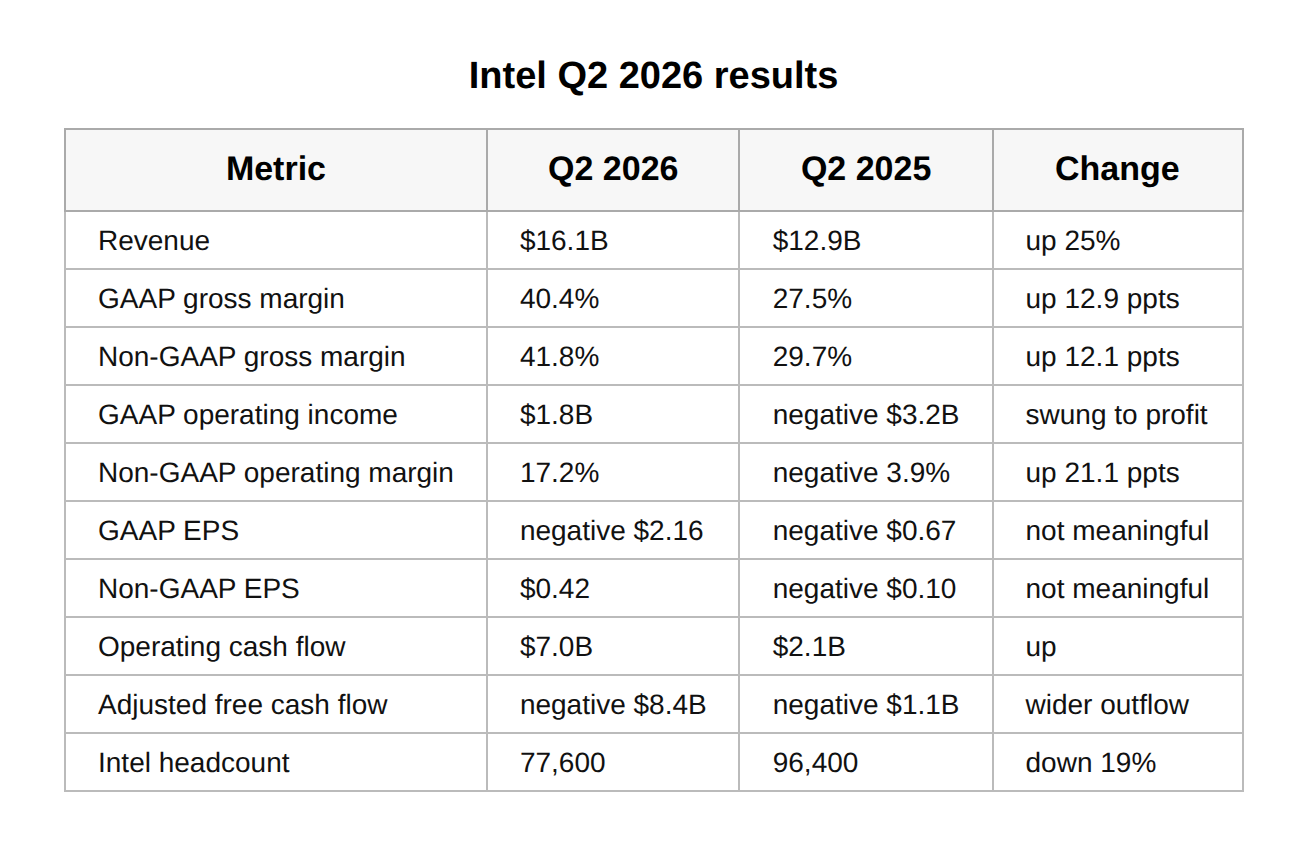
Most investors are carrying one of two Intel stories: the dying x86 chipmaker losing ground to AMD and Arm, or the government-backed momentum trade that has more than doubled this year. Neither describes what the second-quarter numbers actually said. Revenue came in at $16.1 billion, up 25% year on year, the fastest growth rate for any quarter since 2011, per CNBC. Data Center and AI revenue grew 59%. Non-GAAP earnings came in at double what analysts expected, and third-quarter guidance landed well above consensus. Then the stock fell almost 8% the following day. The argument on Wall Street is no longer about whether Intel can make competitive chips. It is about whether Intel can afford to build the factories to make them.
🧩 Not one company, but four
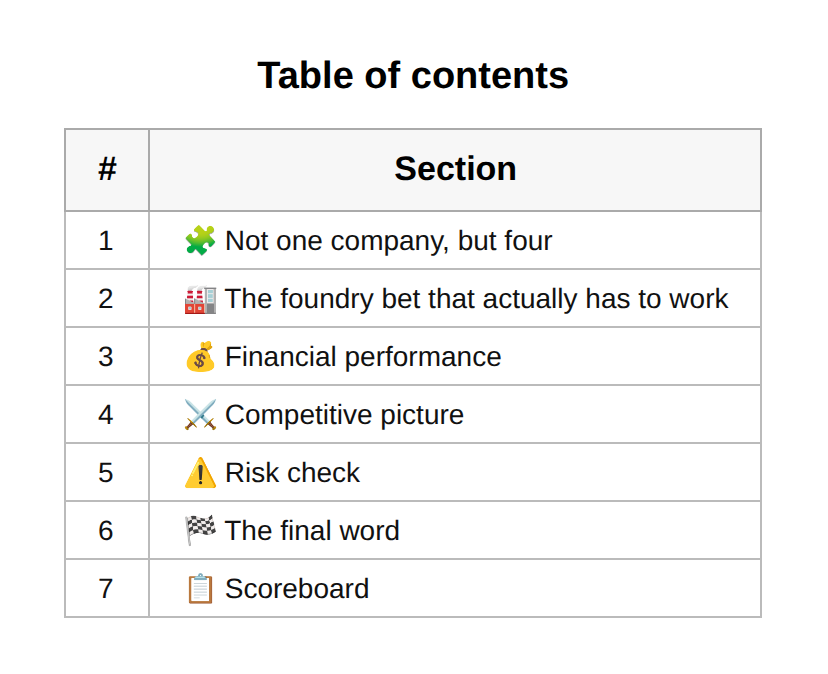
Intel reports as a small number of segments, and the headline revenue figure flattens businesses with completely different economics into one number. Reading them separately is where the quarter gets interesting.
Client Computing and Physical AI, the PC business plus the newer edge and robotics silicon, generated $8.9 billion in Q2, up 13% year on year, with operating income of $2.3 billion, per Intel’s earnings release. This is the cash engine, not the growth story. Management flagged on the earnings call that the second half of 2026 will likely be subseasonal for PCs, because surging memory prices are pushing up the bill of materials for every notebook maker. Intel is deliberately shifting production capacity away from client and toward servers, where the shortage is more acute and the margins are better.
Data Center and AI is the segment that reset expectations. Revenue reached $6.3 billion, up 59% year on year, with operating income of $2.5 billion, which works out to an operating margin close to 40%. A year ago this segment earned $633 million on $3.9 billion of revenue. That is the difference between a business selling commodity server CPUs into a flat market and one selling into a compute shortage. Management said AI-driven businesses collectively grew more than 70% year on year.
Intel Foundry, the contract manufacturing arm, brought in $5.8 billion, up 31%, most of it from making Intel’s own chips. It lost $2.1 billion at the operating line, though that loss narrowed by $348 million from the prior quarter. External foundry revenue, the number that actually matters here, was $293 million, up from $174 million the quarter before. Real progress, and still under 2% of company revenue.
All other, which includes Mobileye and the mask operations business, contributed $0.7 billion, down 33% year on year, largely because Altera was deconsolidated in September 2025.
The shape of this is a products company that has become genuinely profitable again, attached to a manufacturing business that is still losing roughly $8 billion a year on an annualised basis and needs outside customers to stop doing so.
🏭 The foundry bet that actually has to work
Everything in the Intel thesis funnels into one question: does 14A land, and does anyone outside Intel commit to it?
Here is the state of play. Intel 18A, the node the company bet its credibility on, is working better than management guided. CFO David Zinsner said on the call that 18A output ran roughly 25% above target in the quarter and more than 50% higher sequentially. Intel 18A-P entered risk production on the timeline shared with customers a year ago. Panther Lake, the Core Ultra Series 3 family, is in high-volume manufacturing using ASML’s High NA EUV tooling, and Xeon 6+ became Intel’s first server-class product built on 18A.
Intel 14A is where the commercial case sits. On the call, CEO Lip-Bu Tan said defect density and transistor performance are running ahead of schedule, that PDK 0.5 is complete, and that PDK 0.9, the design kit external customers need before they can commit silicon, remains on track for October 2026. Risk production is targeted for the second half of 2027, and Intel made the decision during Q2 to fully commit to a high-volume ramp in 2028. Tan’s framing was that customers get serious once they can see the design kit and the yield data for themselves.
Then there is Fortinet. On 21 July, two days before earnings, Intel announced that Fortinet would build its next-generation Security Processor 6 at Intel’s Fab 34 in Leixlip, Ireland, on the Intel 4 process, with Intel handling design, packaging and manufacturing. The stock rose about 8.6% that day to close at $105.45, per market data. This is the first external foundry customer Intel has been willing to name since Tan took over in March 2025, and Fortinet’s previous generation chip was made by TSMC, so it is a competitive win rather than a courtesy announcement.
It is also not the win Intel keeps promising. Intel 4 is an older node that has been reserved for Intel’s own products, and neither company disclosed the dollar value. In an April filing, Intel acknowledged it was still trying to secure a significant customer for its most advanced process technology. That sentence has not changed.
What did change is the spending. Zinsner raised 2026 capital expenditure guidance to more than $20 billion from roughly $18 billion, said tooling spend alone is up around 40% versus 2025, and said 2027 capex will be significantly above 2026, with the vast majority of it inside the US network. He also said Intel is aggressively locking in tool purchase orders and accelerating clean room build-outs. On the call he noted that CHIPS Act investment tax credits return roughly 35 cents on the dollar for qualifying US investment, which softens the gross number considerably.
The most underappreciated detail of the quarter: memory, not wafers, is now the binding constraint. Tan said memory is the big supply constraint challenge, that Intel is working with all three large memory vendors, and that the company is looking at how to integrate compute and memory more efficiently. Intel also hired Seok-hee Lee, formerly chief executive of SK hynix, to run advanced packaging. A company that spent a decade being outmanoeuvred on manufacturing has just hired one of the most experienced memory operators in the industry to sit inside its packaging organisation.
Want to add Intel to your portfolio? Trade $INTC directly from India on the Winvesta app. No US bank account needed!
🚀 Join 60,000+ investors, become a paying subscriber or download the Winvesta app and fund your account to get insights like this for free!
💰 Financial performance
The figures below are drawn from Intel’s Q2 2026 earnings release, published on 23 July 2026 for the quarter ended 27 June 2026.