


Judging an investment bank meant checking its net interest margin, its trading revenue, and maybe one headline merger a quarter. Not anymore. Global capital markets just had their most extreme half-year on record, anchored by two individual stock sales that redefined what “biggest ever” means, and Goldman Sachs had a seat at the table on both. That’s a different kind of bank than the one most portfolios are pricing in. That’s why we built Winvesta Crisps, to decode what’s actually driving the companies you own, in plain language, before the consensus catches up. 60,000+ investors from all over India are already in. What about you?
🔔 Don’t miss out!
Add winvestacrisps@substack.com to your email list so our updates never land in spam.
Most investors still size up Goldman Sachs the way they’d size up any bank: quarterly trading revenue, net interest margin, maybe a marquee merger mandate every few months. That framing missed what actually happened in the first half of 2026. Goldman sat lead-left on SpaceX’s $85.7 billion initial public offering, the largest in history. A month later, it was one of four banks pricing SK Hynix’s $26.5 billion Nasdaq listing, the largest ADR sale ever completed by a foreign company. Layer in the busiest six months for global mergers on record, and Goldman isn’t just showing up to advise the biggest deals of the year. It is underwriting them, collecting a fee on nearly every major capital-raising event happening in public markets right now, and Tuesday’s earnings will be the first real readout of what that is worth.
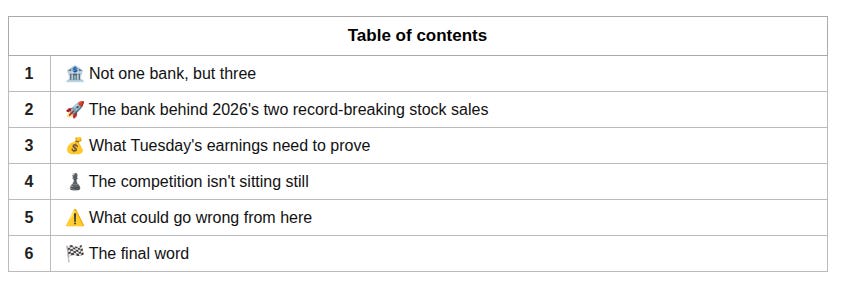
🏦 Not one bank, but three

Goldman reports through three segments, and the split explains why this quarter matters more than a typical bank earnings day.
Global Banking & Markets is the engine. In the first quarter of 2026, it delivered a record $12.74 billion in net revenue, up 19% year over year. Investment banking fees inside that segment jumped 48% to $2.84 billion, with advisory revenue alone up 89% to $1.5 billion as Goldman held the number one ranking among global M&A advisors, with an announced deal-volume lead of roughly $150 billion over its closest peer, per the firm’s earnings materials. Equities trading posted a record $5.3 billion in net revenue, while fixed income, currencies and commodities added another $4 billion. Marquee, Goldman’s institutional trading and research platform, saw monthly active users climb more than 30% year over year, a sign the digital plumbing behind all this is scaling too.
Asset & Wealth Management is the compounding machine underneath. Assets under supervision hit a record near $3.7 trillion in the first quarter, and the division logged its 33rd consecutive quarter of positive long-term fee-based inflows, roughly $62 billion worth. CEO David Solomon has put a specific number on where he wants this to go: $750 billion in alternative assets under supervision by 2030, up from roughly $429 billion today, built on a private credit and private equity opportunity Solomon himself has sized at more than $3.5 trillion. Two acquisitions closed inside this window alone: Industry Ventures for venture capital secondaries, and Innovator Capital Management for ETFs, the latter instantly putting Goldman among the top 10 global providers of active ETFs.
Platform Solutions is the part of the business Goldman would rather investors forget. Revenue there fell 33% year over year to $411 million in the first quarter, largely because the Apple Card partnership is being wound down and held for sale. It’s a small, shrinking slice of a much larger machine, and its decline is arguably good news: Goldman’s consumer-banking detour is finally closing out.
🚀 The bank behind 2026’s two record-breaking stock sales

Two deals define why Goldman’s setup looks different heading into this print.
SpaceX’s initial public offering priced on June 11 at $135 a share, valuing Elon Musk’s company at roughly $1.75 trillion, the largest IPO valuation on record. Once underwriters exercised their overallotment option days later, the deal had raised $85.7 billion, more than three times what Alibaba raised in its 2014 listing, the previous record holder. Goldman sat lead-left, the senior structuring and advisory role, and alongside Morgan Stanley earned roughly $100 million in fees from that single transaction, per Fortune’s reporting on the fee structure. Total underwriting fees across the syndicate ran to roughly $646 million.
A month later, Goldman turned up again as one of four joint lead underwriters, alongside Bank of America, Citigroup and JPMorgan, on SK Hynix’s $26.5 billion American Depositary Share offering, which priced at $149 per ADS and began regular Nasdaq trading this week. It’s the largest ADR offering in history and the largest-ever US listing by an Asian issuer, and the order book came in more than seven times oversubscribed, per InsiderFinance’s reporting.
Those two deals alone would make for an unusual year. They landed inside a half-year that was already the busiest on record for global dealmaking. Mergermarket put total global M&A volume at $3.16 trillion for the first half of 2026, up 44% year over year, while other trackers put the figure closer to $2.7 to $2.8 trillion, still the strongest half-year in close to two decades by most counts. Technology led every sector for a tenth straight quarter, powered by OpenAI’s $122 billion funding round and SpaceX’s roughly $250 billion acquisition of xAI, which alone accounted for close to 30% of total announced deal value in the first quarter. Goldman picked up its own share of that wave too: notable advisory mandates included Unilever’s roughly $43 billion move for McCormick, Sysco’s roughly $29 billion deal for Jetro, and a roughly $26 billion transaction between Cortera and Devon, alongside an advisory role on Trimble’s sale of its transportation unit and an expanded share of EMEA M&A mandates in the first half of the year. Closer to home for wealth clients, Goldman also picked up roughly $70 billion in retirement-plan wins with Verizon and Lockheed Martin earlier this month.
Want to add Goldman Sachs to your portfolio? Trade $GS directly from India on the Winvesta app. No US bank account needed!
🚀 Join 60,000+ investors, become a paying subscriber or download the Winvesta app and fund your account to get insights like this for free!
💰 What Tuesday’s earnings need to prove

Goldman reports second-quarter results before the market opens on Tuesday, July 14, and the first quarter it just posted set a genuinely high bar. Net revenue came in at $17.23 billion, up 14% year over year, with net earnings of $5.63 billion and diluted earnings per share of $17.55, the second-highest quarterly EPS in the firm’s history and a beat of roughly 7% against a Wall Street consensus estimate near $16.40, per multiple analyst trackers. Return on equity ran at 19.8% and return on tangible equity at 21.3%. Goldman returned $6.38 billion to shareholders in the quarter, split between $5 billion of buybacks and $1.38 billion of dividends, while holding a common equity tier 1 capital ratio of 12.5%, comfortably above its 11.4% regulatory requirement.