



Buying gold when markets got choppy was the kind of contrarian move most investors quietly dismissed. Not anymore. Central banks have been buying gold at near-record levels — 2022 through 2025 saw some of the most aggressive official-sector accumulation in modern monetary history. The dollar’s status as the world's reserve currency is being actively questioned. And a tariff war that’s rewiring global supply chains has turned “why would anyone own gold when stocks compound?” into “why would anyone not?” If you don’t understand why gold ETFs are at all-time highs — and more importantly, whether you’re arriving as an early thesis buyer or as exit liquidity for institutions who positioned six months ago — your “haven” allocation might be doing the opposite of what you think.
That’s why we built Winvesta Crisps, to decode what’s actually moving the assets you own, in plain language, before the consensus catches up. 60,000+ investors from all over India are already in. What about you?
🔔 Don’t miss out!
Add winvestacrisps@substack.com to your email list so our updates never land in spam.
Gold is trading at approximately $4,700–4,800 per troy ounce, close to all-time highs — though it has pulled back from a 2026 peak reached in late January. The SPDR Gold Shares ETF (GLD) surged to a 2026 high above $500 per share in late January, then pulled back to the mid-$440s, still up sharply on the year. Your investing group chats are full of screenshots. Financial media is running “gold bull market has further to run” headlines every other day. And somewhere between Trump’s tariff spiral, a structurally pressured dollar, and central banks buying bullion at levels not seen in the post-Cold War era, a “boring hedge” has quietly become one of 2026’s best-performing assets.
Here’s what nobody is saying out loud: when a safe-haven asset has surged this sharply and is now pulling back from peaks, it is no longer acting like a haven. It’s acting like momentum. And the retail investors rushing into GLD today deserve to ask a harder question than “gold always goes up when things are uncertain.”
Let me introduce you to someone who might be you.
🎯 Think you're not Deepak? Let's find out
Deepak, 36, software engineer in Bengaluru. Portfolio: ₹38 lakhs across US markets. He’s been methodically building a QQQ and VOO core over the past two years through Winvesta. In late 2025, when Trump’s tariff posturing intensified, Deepak made a smart call: he added ₹2.2 lakhs to GLD as a hedge against uncertainty. He was early. Gold has surged since.
Now gold is at record-high territory but has pulled back from January peaks; his GLD position is up roughly 22%, and his investing-circle notifications are relentless. He’s seriously considering adding ₹3–₹ 4 lakh more. Here’s what Deepak thinks he owns versus what he actually owns:
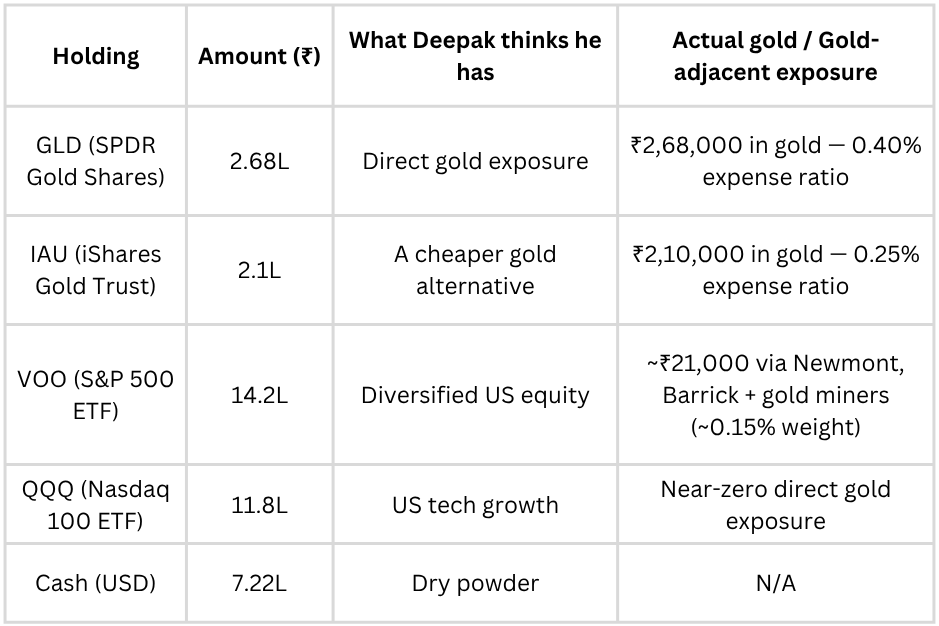
Note: ETF weights are approximate and shift daily. The above is illustrative of the concentration picture, not a precision audit.
Deepak’s reality check: He has approximately ₹4.8 lakhs in direct gold ETF exposure — roughly 12.6% of his US portfolio. That’s nearly double the 5–8% gold allocation most portfolio frameworks suggest as a maximum for a diversified long-term investor. And he’s considering adding ₹3–4 lakhs more, which would push his gold concentration above 20%.
Here’s the question he hasn’t asked himself: if he bought GLD as a hedge against tariff-driven uncertainty, and GLD is already up 22%... is the hedge still a hedge? Or has it become his most crowded trade?
That question is the difference between smart portfolio construction and chasing a narrative at its most consensus moment.
📊 What ETF flows actually tell you
ETF flows don’t lie. When institutional money is building conviction, flows are steady, quiet, and spread over months. When retail money is chasing a story, flows spike suddenly — after the move has already happened.
Here’s the approximate directional picture in gold ETFs over the past four weeks (mid-March through mid-April 2026):
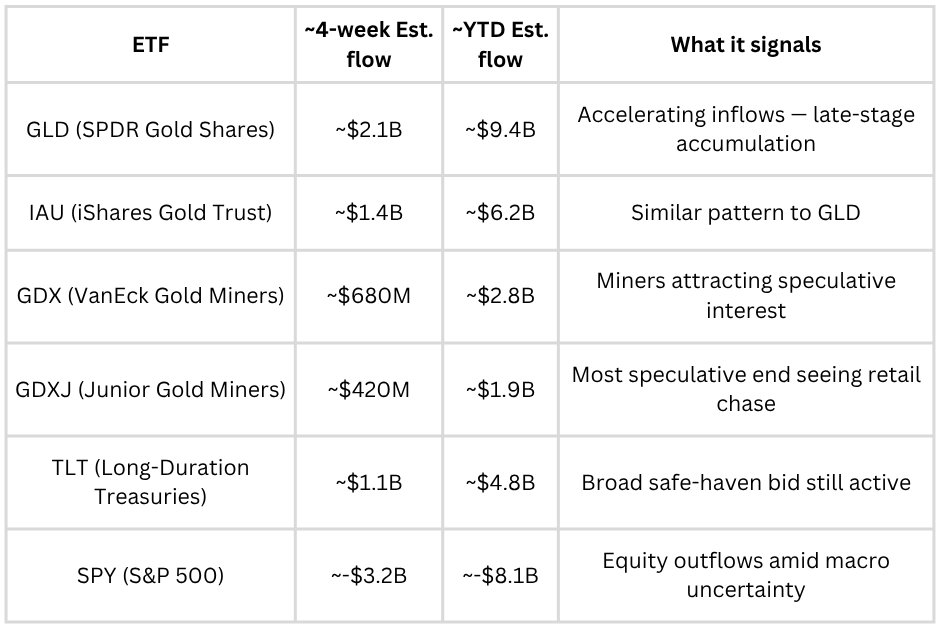
Note: Precise weekly flow figures vary by data provider and reporting lag. The above is directional and illustrative, not drawn from a single audited dataset. Cross-reference with Bloomberg, ETF.com, or TrackInsight before acting.
Here’s the pattern that should give you pause: GLD and IAU absorbed more capital in the past four weeks than in many full quarters of 2025. That’s not institutional accumulation. That’s institutional completion — meaning the investors who positioned six to nine months ago are now quietly distributing shares to the investors who just read a Bloomberg headline.
The tell is in the junior gold miners (GDXJ). When speculative fringe products see inflows at this velocity relative to their historical base, you’re in the late innings of a momentum trade, not the early stages of a structural rotation. Based on our directional read of available flow data, the last time GDXJ appeared to see inflows at a comparable velocity was summer 2020 — right before gold corrected roughly 15% over the following six months. This comparison is directional rather than based on a single audited dataset; exact flow figures should be verified against the data terminal before acting.
The second tell: SPY outflows running simultaneously with gold inflows has historically been a more reliable buy signal for equities over a 3–6 month horizon than a sustained signal for gold. When fearful capital exits stocks en masse, the pendulum tends to swing back.
🧠 The psychology trap
Right now, your brain is working overtime to tell you gold is different from every other momentum trade. Here’s the story it’s constructing:
✅ “Central banks have been buying gold for three straight years — that’s structural demand!”
✅ “The dollar is being weaponised through tariffs — gold is the natural hedge!”
✅ “Inflation is sticky, and the Fed can’t cut — gold wins in stagflation!”
✅ “Every analyst I follow says gold goes to $5,500 — the consensus is bullish!”
Every single one of these arguments is factually grounded. Central bank buying is real. Dollar credibility is being tested. The macro case for gold is as strong as it’s been in decades.
But here’s the cognitive trap: all of those arguments were also true twelve months ago, when gold was trading around $3,300 — well before this latest leg higher. The commodity didn’t change. The structural story didn’t change. What changed is that the price surged past $5,000 in late January — with some reports of intraday spikes into the mid-$5,000s — and has since pulled back, which made everyone who wasn’t paying attention suddenly pay attention. You’re not responding to new information. You’re responding to price action dressed up as thesis validation.
Here’s how the pattern has played out before:
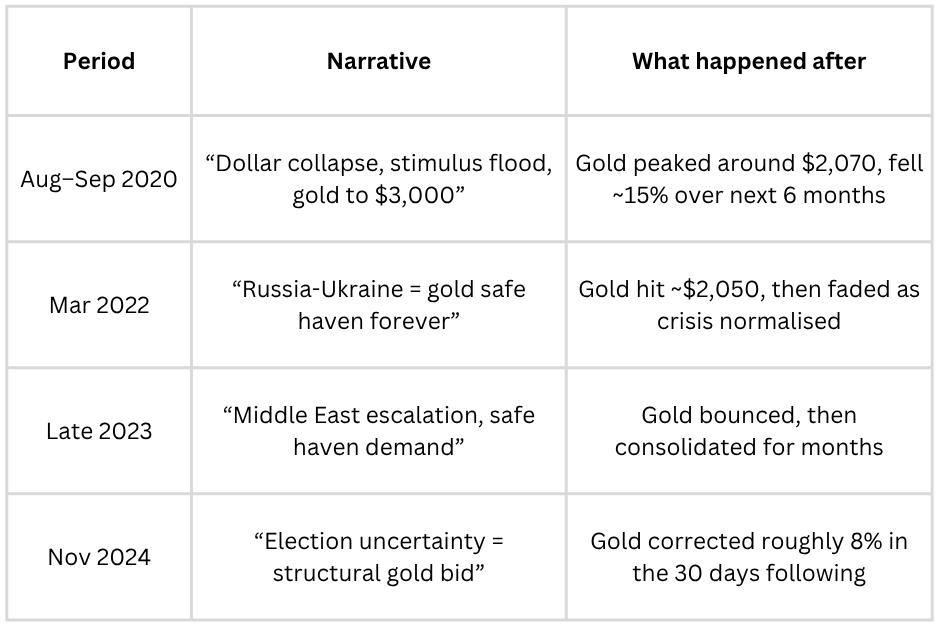
Past percentage moves are approximate. The pattern is directional, not a precise prediction of what follows.
None of this is a guaranteed template for what happens next. But the setup rhymes.
The rational vs FOMO checklist:
Ask yourself honestly:
❌ Can you explain why gold at $3,300 is a better risk/reward than it was at $2,700?
❌ Do you understand what happens to GLD if the Fed signals it’s done hiking AND a preliminary trade deal gets announced on the same week?
❌ Would you be adding gold today if GLD hadn’t posted such a massive run from last year’s levels?
❌ Do you actually know the difference between what GLD, IAU, and SGOL hold — and why you’d pick one over the others?
If you answered “no” to three or more, you’re not making an investment decision. You’re making a momentum decision and calling it a hedge.
🚀 Want to add GLD, IAU, or GDX to your portfolio? Trade these ETFs directly from India on the Winvesta app. No US bank account needed!
Join 60,000+ investors, become a paying subscriber or download the Winvesta app and fund your account to get insights like this for free!