Buying gold the moment a scary headline broke was close to a reflex trade, and it usually paid off. Not anymore. The US and Iran have been fighting an actual war since late February, oil jumped more than 20% in July alone, and gold is still sitting close to 28% below its January peak. The old rule (war breaks out, gold goes up) has stopped working this year, because the war has been feeding inflation and a hawkish Fed more than it has fed fear. That’s why we built Winvesta Crisps, to decode what’s actually moving the funds you own, in plain language, before the consensus catches up. 60,000+ investors from all over India are already in. What about you?
🔔 Don’t miss out! Add winvestacrisps@substack.com to your email list so our updates never land in your spam folder.
Brent crude fell close to 5% this morning after Donald Trump said talks with Tehran would begin today, and that he’s holding off on further major strikes to give the negotiation room to work. Indian markets liked it. The Sensex and Nifty both opened firmly higher on the news. If you hold gold ETFs through Winvesta, you might expect your portfolio to like it too. You’d be wrong to expect that, and the gap between what should happen and what has actually happened all year is the whole story.
Gold peaked above $5,500 an ounce in late January, in the same stretch of tariff and war anxiety that first put this trade on every Indian investor’s radar. It has spent the seven months since falling, not in a straight line, but falling all the same, even while a live war has run in the background the entire time. Most investors assume an actual war is bullish for gold. This year, the data says something else.
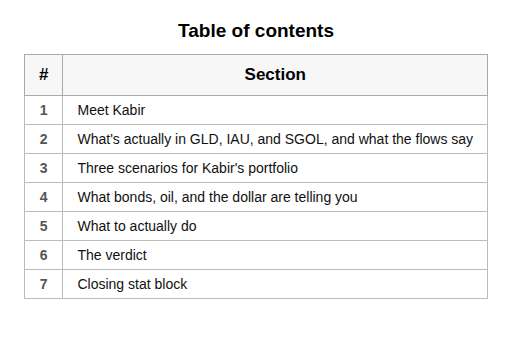
🎯 Meet Kabir
Kabir, 35, works in operations for an FMCG company in Mumbai. Portfolio: ₹46 lakh across US markets through Winvesta. He built a simple core over three years: VOO for the S&P 500, QQQ for tech growth, and cash on the side for whatever came next.
In mid-April this year, with tariff headlines everywhere and the Iran war already seven weeks old, he added ₹9.6 lakh to GLD as a hedge. Gold was trading in the mid-$440s to high $460s at the time, well off its January top but still widely described as the trade of the year. He bought at roughly $460 a share.
Today that position is worth about ₹7.85 lakh. He’s down close to ₹1.75 lakh, or 18%, on a hedge he added specifically because things felt uncertain. Things are, if anything, more uncertain now. There is a live war. Oil swung more than 20% in a single month. The Fed is split three ways on whether to hike. And his “safe” asset is the one that’s lost him money.
Here’s Kabir’s portfolio as it actually stands:
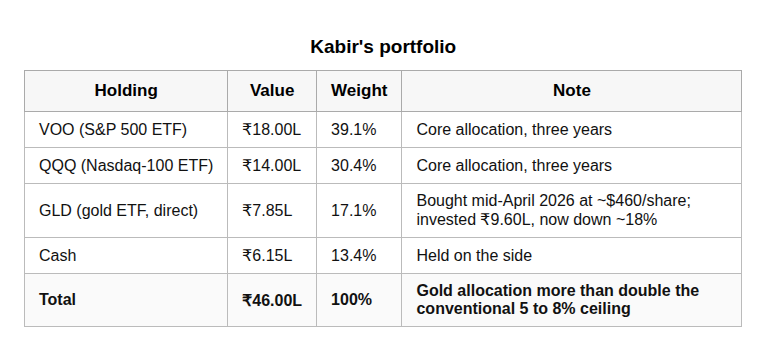
Kabir’s gold allocation sits at roughly 17% of his US portfolio. Every mainstream framework, including the ones we’ve cited in past editions, puts the sensible ceiling for a diversified portfolio at 5 to 8%. He’s more than double that, and he got there without ever making an active decision to run this concentrated. He just kept adding to what felt like the obvious hedge, while the position did the opposite of what a hedge is supposed to do.
This morning, watching Sensex futures jump on the Iran de-escalation news, Kabir checked his GLD price out of habit. It barely moved. That’s the moment he messaged us. If a war easing off doesn’t move his gold position, what was the point of holding it through the war in the first place?
That question is worth answering properly, because the honest answer is not “sell everything,” and it’s not “hold and hope” either.
📊 What’s actually in GLD, IAU, and SGOL, and what the flows say
Three large, physically backed gold trusts dominate this trade for Indian investors accessing US markets: GLD (SPDR Gold Shares), IAU (iShares Gold Trust), and SGOL (abrdn Physical Gold Shares). All three hold allocated gold bullion in vaults and exist purely to track the metal’s price, minus fees. None of them pay a dividend. The difference between them is cost and, to a smaller degree, structure.
GLD is the oldest and by far the largest, with roughly $130 billion in assets and a 0.40% expense ratio. IAU tracks the same gold price at a 0.25% expense ratio, a meaningful saving on a position you plan to hold for years. SGOL, the smallest of the three, charges just 0.17% and vaults its gold in Switzerland rather than the more commonly used London or New York facilities, which some investors treat as an extra layer of diversification. For a new position with no legacy tax lot to worry about, IAU or SGOL is the cheaper way to own the same asset. GLD’s main advantage is liquidity: tighter spreads and deeper options markets, which matters more to traders than to someone holding for years.
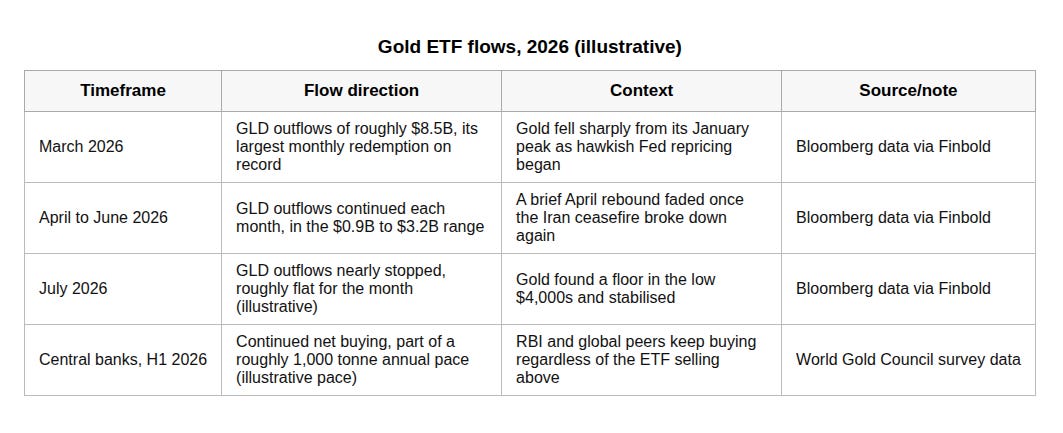
Where this gets interesting is the flow data, because two very different types of buyers have been doing completely opposite things with the same asset.