


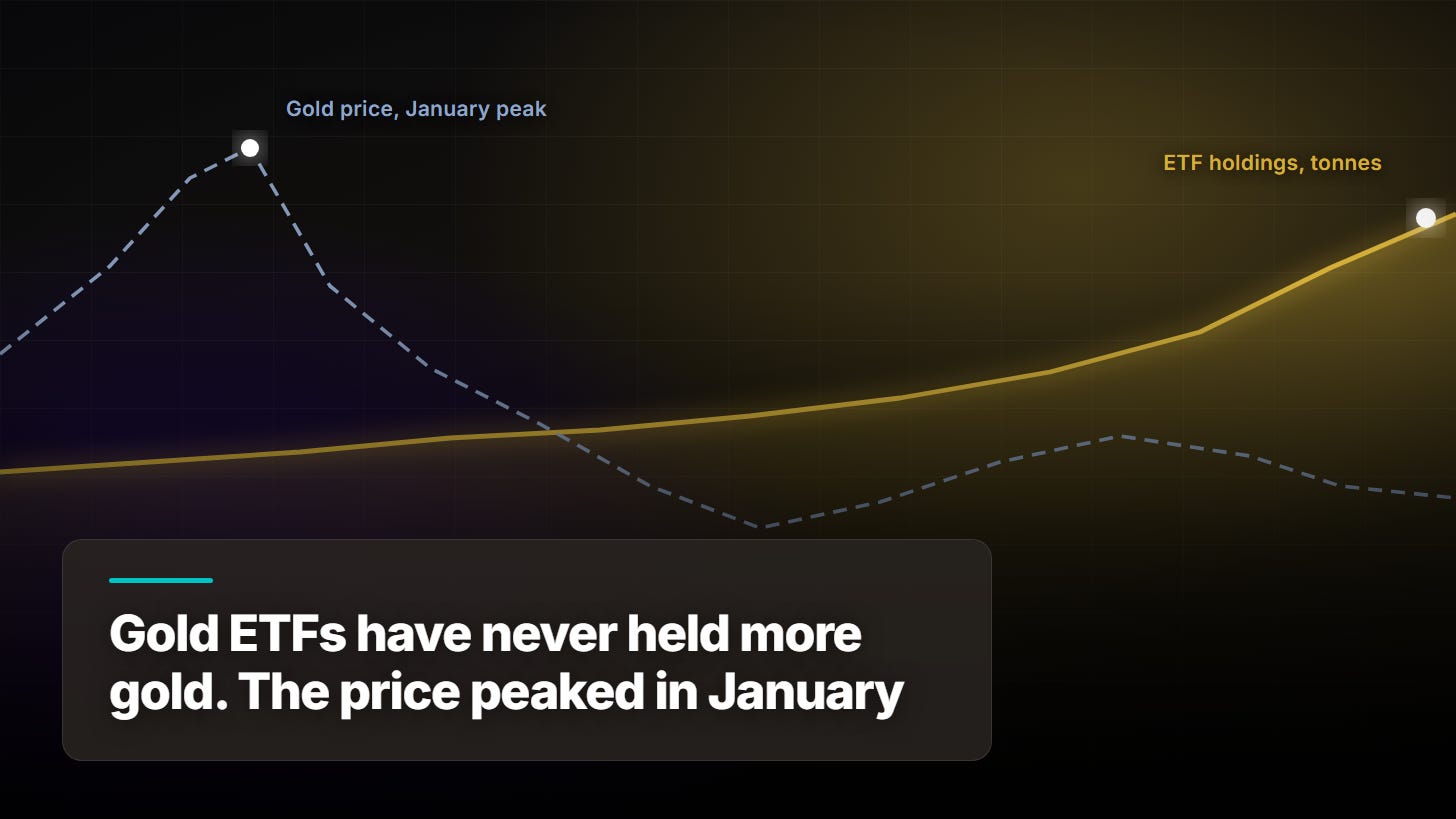
Five years ago, owning gold from India meant a locker, a jeweller's making charge and a vague sense that it would hold its value. Not anymore. Gold funds worldwide now hold a record 4,189 tonnes after taking in roughly $18 billion in August, the second largest monthly inflow ever recorded, per the World Gold Council. The metal itself topped out at around $5,600 an ounce in January and trades near $4,290 today. That's why we built Winvesta Crisps, to decode what's actually moving the funds you own, in plain language, before the consensus catches up. 60,000+ investors from all over India are already in. What about you?
🔔 Don't miss out!
Add winvestacrisps@substack.com to your email list so our updates never land in spam.
Two records were set this year, nine months apart, and almost nobody has noticed they point in opposite directions.
The first was the price. Gold peaked at roughly $5,590 to $5,600 an ounce on 28 and 29 January 2026, capping a run that had already delivered more than 60% in 2025, the metal's best year since 1979. It then fell about 28% into a seven month low near $4,000 in June, the steepest quarterly correction since 2013.
The second record was the ownership. Global gold ETF holdings hit an all time high of 4,189 tonnes in August, with assets under management at $615 billion, per the World Gold Council. Indian investors did the same thing at home: gold ETF inflows reached ₹2,596.70 crore in August, up about 67% on July's ₹1,559 crore and the third straight month of net buying, per AMFI data released on 10 September.
So the largest wave of gold buying on record arrived seven months after the top, into a metal that is up roughly 0.6% for the year in dollar terms.
Most investors see a gold rally and assume they are late to a winner. What the data says is stranger. They are early to a position that has already stopped working, and the Federal Reserve meets today and tomorrow with roughly 89% odds of raising rates, per fed funds futures pricing reported on 14 September.
🎯 Meet Kabir
Kabir is 41, runs a mid-sized logistics business out of Pune, and has been investing in US markets from India since 2021. His financial assets come to roughly ₹85 lakh, split between a broad S&P 500 fund, a handful of US large caps, and about ₹6 lakh he put into an Indian gold ETF across July and August this year.
His family also owns gold. Perhaps 400 grams of it, mostly inherited, sitting in a bank locker in his mother's name. He has never counted it as part of his portfolio. That omission is the first thing worth fixing.
He bought the gold ETF for reasons that sounded sensible at the time. Domestic gold prices on the MCX rose 7.7% during August alone. The rupee was weakening. Everyone he follows was talking about central banks hoarding bullion. He was, in his own description, hedging.
Since he finished buying, gold has gone the other way. It closed August at $4,431.82 an ounce and trades near $4,287 now, a fall of roughly 3% in a fortnight. The 10 year US Treasury yield touched 5.014% on 14 September, its highest since October 2023, per CNBC.
His question is the one worth answering this week: he owns gold in two forms, he added to the noisier one at what looks like a local high, and the safest asset in the world now pays him 5% to do nothing. What should he actually do?
📊 What you are buying when you buy a gold fund
A physically backed gold ETF is close to the simplest product in finance. The fund holds bullion in a vault, issues shares against it, and charges you a fee. There is no cash flow, no earnings, no management team to get it wrong. The share price tracks the metal minus the fee, and the fee is the only thing you control.
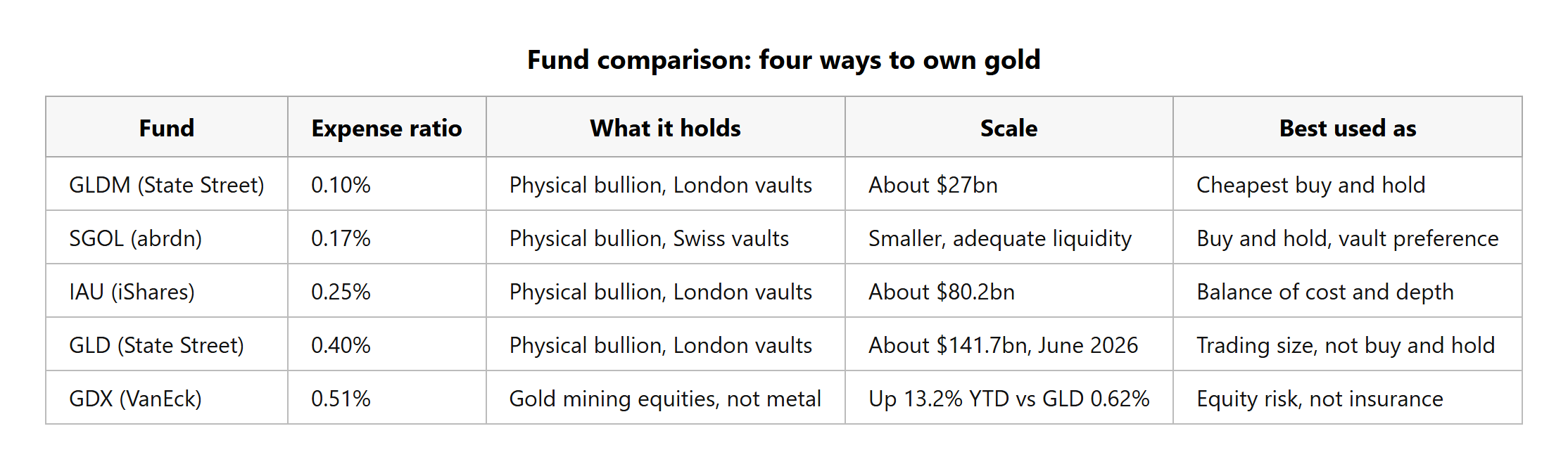
The spread between those fees is the whole decision on the US side. SPDR Gold Shares, ticker GLD, is the oldest and most liquid at roughly $141.7 billion of assets as of June 2026, and charges 0.40%. The iShares fund, IAU, charges 0.25% on about $80.2 billion. State Street's own smaller sibling, GLDM, charges 0.10%. Aberdeen's SGOL sits at 0.17% and vaults in Switzerland rather than London, which matters to a particular kind of investor and to nobody else.
All four hold the same metal. Over a ten year hold, the difference between GLD and GLDM compounds to roughly 3% of the position, which is real money for an asset that has returned about 0.6% so far this year.
Gold miners are a different instrument wearing similar clothing. The VanEck Gold Miners fund, GDX, is up about 13.2% year to date against GLD's 0.62%, because a miner's costs are broadly fixed while its revenue moves with the metal. All in sustaining costs for large producers typically run around $1,200 to $1,400 an ounce, so a move in the gold price lands almost entirely in the margin. That operational gearing works in both directions, and GDX has drawn down more than 45% inside the last year.