



“Buy gold whenever the world looks scary” was close to a complete thesis. Not this year. Central banks bought gold at a near-record pace through the first half of 2026 while ETF investors pulled money out at the same time, and gold still managed a 26% drawdown from its January high. That gap between official sector conviction and retail panic is the real story right now, and it doesn’t fit in one line. That’s why we built Winvesta Crisps, to decode what’s actually moving the funds you own, in plain language, before the consensus catches up. 60,000+ investors from all over India are already in. What about you?
🔔 Don’t miss out! Get the latest updates delivered straight to your inbox →
Gold is down 26% from the all time high it set on January 29, 2026. Most investors reading the headlines figure that means the gold trade is over. The World Gold Council’s data says otherwise: central banks bought gold through the first half of 2026 at a pace that pushed bullion past US Treasuries as the world’s largest reserve asset, even as retail money fled gold ETFs by the tonne. Two of the most sophisticated buyer groups in the market are looking at the same asset and doing the opposite thing. If you own GLD, IAU, or SGOL, that split isn’t background noise. It’s the question you need answered before you touch your position again.
🎯 Meet Karan, and the gold position he can’t quite look at

Karan, 36, works in operations at a SaaS company in Chennai. His US portfolio through Winvesta is worth ₹52 lakh, built over four years of steady contributions into a mix of index funds and a handful of single stocks.
On January 27, 2026, two days before gold touched its record high of $5,595 an ounce, Karan put ₹8.4 lakh into GLD. He’d watched gold roughly double in under two years and didn’t want to miss the next leg. By early June, gold had fallen more than 20% from that peak, and Karan did what a lot of investors do when a position turns red: he added more. ₹2.6 lakh went into SGOL in the first week of June, in the low $4,000s, in what he told himself was “averaging down,” just days before gold broke below $4,000 for the first time since November 2025.
Today, that combined position is worth roughly ₹9.1 lakh against ₹11 lakh invested, a paper loss of about ₹1.9 lakh, or 17%. The GLD tranche is down close to 24% from Karan’s entry. The SGOL tranche, bought nearer the recent lows, is up a couple of percent. Gold ETFs now make up about 17% of Karan’s portfolio; he’d originally planned for 15%, as a hedge, not a bet.
Here’s what makes Karan’s situation harder than a plain “buy the dip or cut the loss” call: the two biggest categories of buyer in the gold market right now don’t agree with each other, and neither one is retail.
🪙 What’s actually inside GLD, IAU, and SGOL, and where the money is really flowing
All three ETFs in Karan’s position do the same basic job: hold physical gold bars in a vault and issue shares that track the price, minus a small annual fee. The differences show up in cost and custody, and they start to matter once a position gets this large.
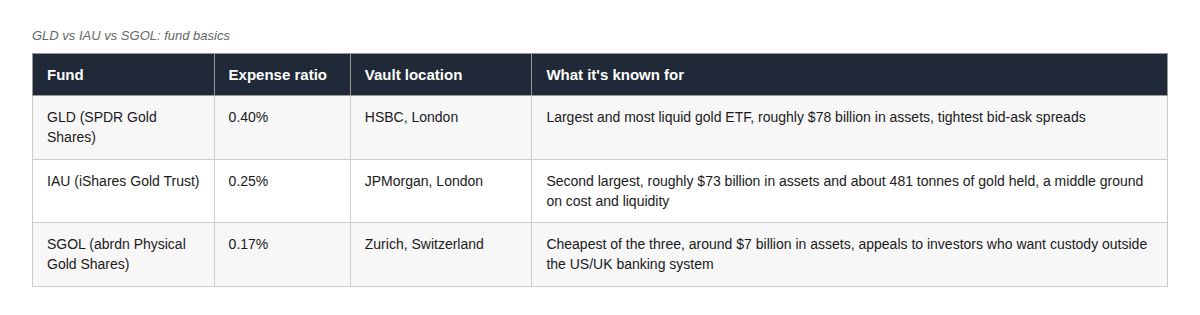
On a ₹10 lakh position held for ten years, the gap between GLD’s 0.40% fee and SGOL’s 0.17% works out to roughly ₹23,000 in cumulative costs. Not huge, but not nothing.
The bigger question is what’s happening to the money moving in and out of funds like these. The table below is a directional summary of gold ETF flow data reported by the World Gold Council and cited by outlets tracking it through 2026. Treat it as illustrative context, not a live, verified figure for this exact week.
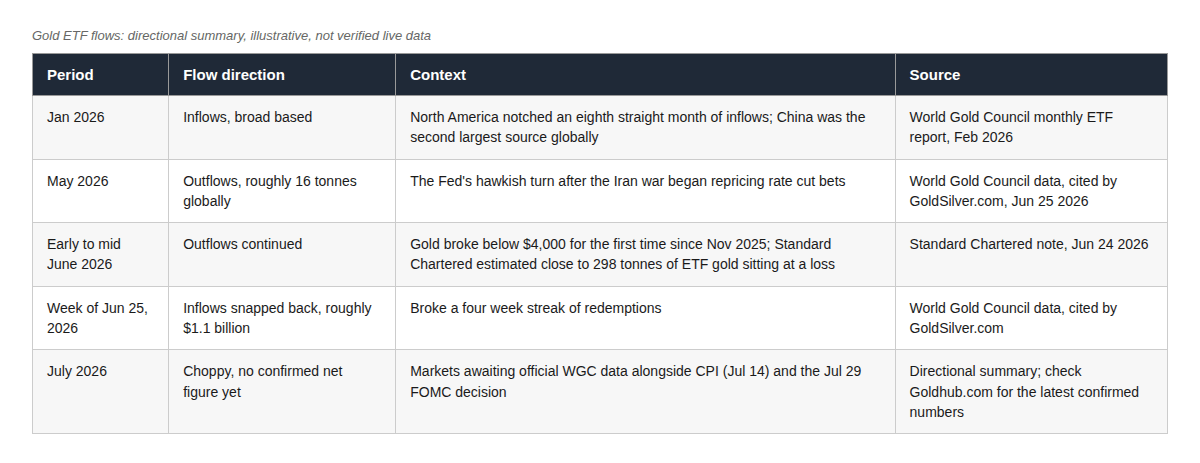
Central banks were not playing the same game. The People’s Bank of China added close to 15 tonnes to its reserves in June, its largest single month purchase since October 2023 and its twentieth straight month of buying. Globally, central banks bought a net 244 tonnes in the first quarter of 2026 alone, up 3% year on year, according to the World Gold Council. By June, the European Central Bank’s own report on the international role of the euro confirmed that gold had overtaken US Treasuries as the largest asset class held across global central bank reserves, a first in modern financial history.
Retail ETF holders were selling into weakness. Central banks were buying through it. Karan’s ₹9.1 lakh position sits right in the middle of that disagreement.
Want to add GLD, IAU, or SGOL to your portfolio? Trade these ETFs directly from India on the Winvesta app. No US bank account needed!
🚀 Join 60,000+ investors, become a paying subscriber or download the Winvesta app and fund your account to get insights like this for free!