


Five years ago, buying a Nasdaq-100 fund meant owning a hundred companies and calling it a day. Not anymore. This week, Microsoft, Alphabet, Meta and Amazon all report earnings in the same stretch the Federal Reserve makes its rate call, and between them those four names already carry more weight in your "diversified" fund than your entire mid-cap sleeve. That's why we built Winvesta Crisps, to decode what's actually moving the funds you own, in plain language, before the consensus catches up. 60,000+ investors from all over India are already in. What about you?
🔔 Don't miss out! Add winvestacrisps@substack.com to your email list so our updates never land in spam.
Most investors treat "I own a Nasdaq-100 fund" as shorthand for "I own a hundred companies, so I'm fine." That shorthand has been getting less true for years, and this week puts it to an unusually direct test. The Magnificent Seven now make up roughly a third of the S&P 500, a touch above 33% per First Trust's latest index tracking, and the concentration inside a pure tech or Nasdaq-100 fund runs higher still. Four of those seven report earnings this week: Microsoft, Alphabet, Meta and Amazon. Sitting in the same week is the Federal Reserve's policy decision on Wednesday, a meeting with no fresh economic projections attached, so the market's main read on the Fed will come from the statement and the press conference alone.
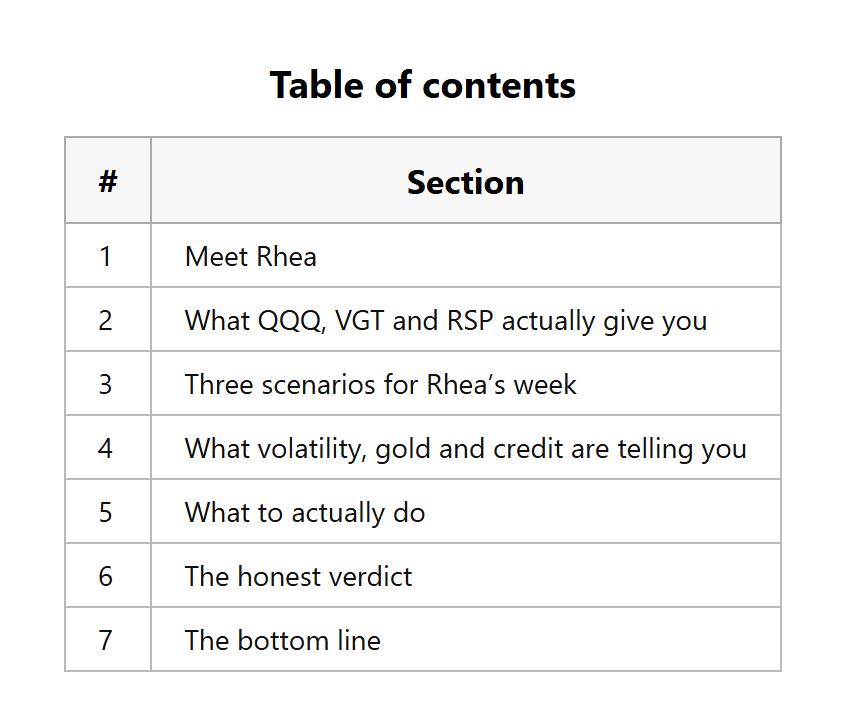
This is not a routine earnings week. It is the second AI-capex reporting cycle of the year that has arrived with real tension already loaded into it. In April, the same four names collectively guided 2026 capital spending toward a combined figure north of $650 billion. In July, two of them, Meta and Alphabet, followed that up with guidance that unsettled the market rather than reassured it: Meta's free cash flow came in sharply lower even as its capex range moved higher, and Alphabet raised its own capex guide again without giving analysts a clean demand story to hang it on. Both stocks fell on the news. Here's what nobody's telling you: if this week repeats that pattern, the investor who feels diversified because they hold "the whole Nasdaq" will take a concentrated hit, not a diversified one.
🎯 Meet Rhea
Rhea is 32, a product manager at a Bengaluru SaaS company, with a US portfolio worth close to ₹52 lakh built up over three years of steady monthly investing into a Nasdaq-100 index fund. She picked it specifically because "it's not just one stock, it's a hundred of the best companies in the world," and has largely ignored the portfolio since, treating the broad name as its own diversification argument.
She has never opened the fund's actual holdings list. If she had, she would see that a handful of names, not a hundred, decide most of what happens to her money in any given quarter, and that this week, four of those names report earnings on the same calendar as a Fed decision she has not been tracking at all.
Her hidden exposure. Nvidia, Apple, Microsoft, Amazon, Alphabet, Broadcom and Meta combined have, across recent fund disclosures, sat at somewhere above a third of her fund's total weight, even before accounting for how those same names dominate the S&P 500 and, by extension, most "global" and "world" equity funds that also happen to be cap-weighted. Rhea thinks she is diversified across a hundred companies. She is actually running a concentrated bet on roughly seven balance sheets, four of which release their next set of numbers inside the next few days.
📊 What QQQ, VGT and RSP actually give you

QQQ, the Invesco Nasdaq-100 fund Rhea actually owns, is cap-weighted, which means the largest companies in the index get proportionally larger slices of every rupee that goes in. Recent fund disclosures put Nvidia, Apple, Microsoft, Amazon and Alphabet's combined share at somewhere in the mid-to-high-20s percentage-wise on their own, before adding Broadcom and Meta, which is precisely why a single capex-guidance surprise from any of this week's four reporters moves the whole fund, not a sliver of it.
VGT, Vanguard's Information Technology fund, is built the same way but narrower, holding only the tech sector rather than the full Nasdaq-100, which pushes the concentration in the same handful of names higher still rather than lower. It is the more aggressive version of the same bet, not a diversified alternative to it.
RSP, the Invesco S&P 500 Equal Weight fund, is the structural counterpoint. It holds roughly the same 500 companies as the standard S&P 500 index, but rebalances every holding back toward an equal slice regularly, so no single name, however large its market value, can dominate the fund's return. Its largest sector exposures each sit in the mid-teens percentage range, a materially flatter profile than either QQQ or VGT. It is not an anti-tech fund. It is a fund that refuses to let seven earnings calls decide its quarter.