


Most investors watched the midterms as a political story. Markets read them as a question about how much any law can change in the next two years. Overnight that answer changed: Democrats are projected to control both the House and the Senate, while the White House stays Republican. That's why we built Winvesta Crisps, to break down what's actually moving markets, in plain language, before the consensus catches up. 60,000+ investors from all over India are already in. What about you?
🔔 Don't miss out! Add winvestacrisps@substack.com to your email list so our updates never land in spam.
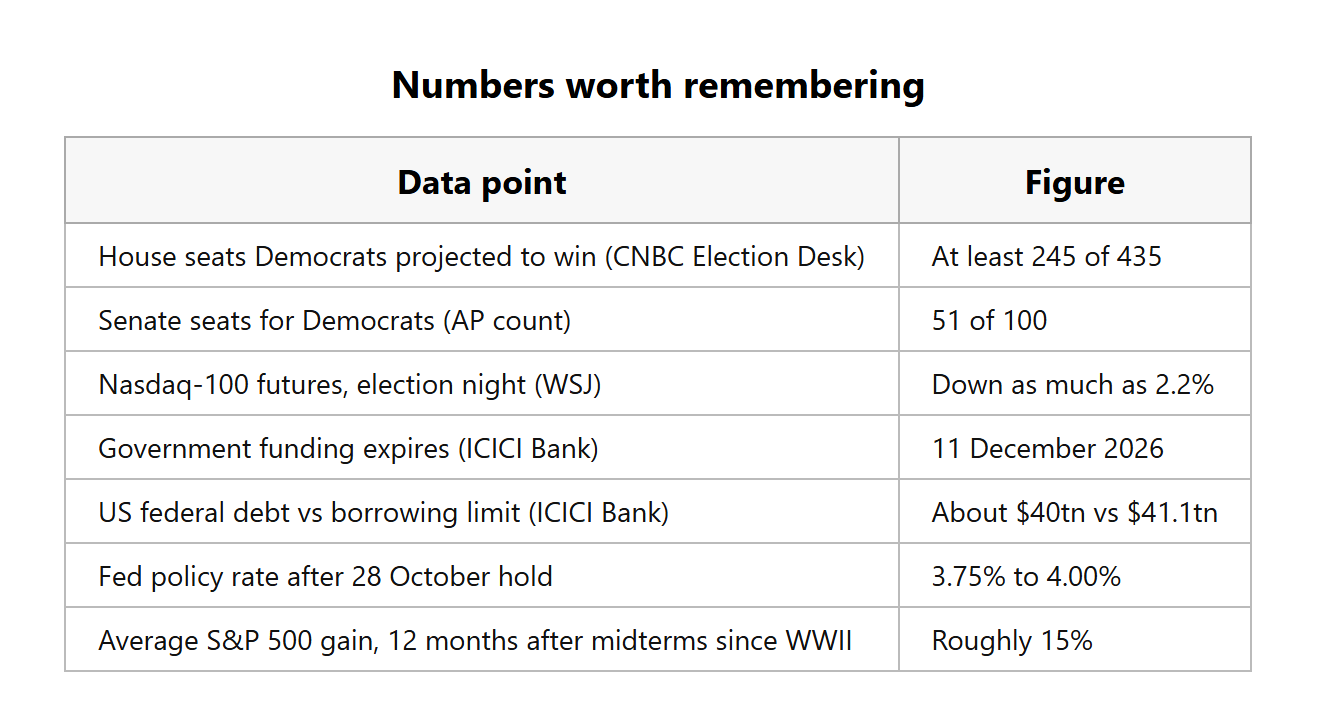
At around 12:40 am in New York, the CNBC Election Desk projected that Democrats would win at least 245 House seats, well past the 218 needed for a majority. The Associated Press count gave them 51 Senate seats, enough for control, after projected flips in Iowa, Kansas, North Carolina, Ohio, South Carolina and Texas. Before the vote, Republicans held the Senate 53 to 47. US stock futures, which had been rising earlier in the evening, turned as the Senate odds climbed. By late night S&P 500 futures were down about 1.1% to 1.3% and Nasdaq-100 futures as much as 2.2%, per CNBC and the Wall Street Journal. Counting is still going on in some races, and the new Congress is seated on 3 January. Most people don't realise how much of what they own is priced on the assumption that Washington can, or cannot, get things done. Here is how that works.
🏛️ What divided government actually means
The United States splits power three ways. Congress writes laws and controls spending. The president signs or vetoes those laws and runs the executive branch. When one party holds the White House and the other holds Congress, very little legislation passes unless both sides want it.
That situation has a name on Wall Street: gridlock. It has a reputation for being good for stocks, for a simple reason. Markets dislike surprises, and a Congress that cannot pass big laws cannot surprise anyone with a new tax, a new regulation or a large spending programme.
The history supports the reputation, with limits. Per analyses of Standard and Poor's data, the S&P 500 has not posted a negative return in the 12 months after any midterm election since the Second World War, with the average gain landing around 15% depending on the dataset and start date. Midterm years themselves tend to be weaker, and markets often recover once the uncertainty of the vote is gone. That record is a pattern, not a promise, and it says nothing about the next few weeks.
⚙️ How a Democratic Congress changes the rules of the game
The headline change is smaller than it looks. To override a presidential veto, Congress needs a two-thirds majority in both chambers, and Democrats are nowhere near that. So the White House can still block any bill it dislikes.
What the new majority does get is three levers, and each one reaches markets through a different channel.
The first is the budget. Congress controls spending, and the current temporary funding arrangement runs out on 11 December, per an ICICI Bank research note. A newly confident Democratic majority (it takes its seats in January, but the lame-duck Congress still has to pass that funding) and a president with a veto pen make a shutdown more likely, not less. PGIM, the asset manager, rates shutdown risk "very high". Shutdowns rarely do lasting economic damage, but they delay official data releases, which makes the Fed's job harder at a time when it is already split.
The second is the debt ceiling. US federal debt stood at roughly 40 trillion dollars in late 2026 against a legal borrowing limit of 41.1 trillion, per the same ICICI note. If the limit is not raised in the lame-duck session, PGIM expects the next standoff to come to a head in the middle to late summer of 2027. Previous standoffs have brought credit-rating downgrades and spikes in Treasury yields.
The third is oversight. House committees can call hearings, demand documents and run investigations. PGIM expects these to target areas such as crypto, betting markets and firms close to senior officials. That is company-level headline risk, not an economy-wide event.
What does not change much is trade. Most current tariffs were imposed by executive action, not by Congress. Democrats can hold hearings and force votes, but undoing tariffs would need either the president's signature or a veto-proof majority. PGIM goes further and expects a White House facing a hostile Congress to lean harder on executive action, which could mean more tariffs, not fewer.
The dynamics covered in this article affect every US stock in your portfolio. Trade from India on the Winvesta app. No US bank account needed!
🚀 Join 60,000+ investors, become a paying subscriber or download the Winvesta app and fund your account to get insights like this for free!
🏆 Who a divided Washington helps and who it hurts
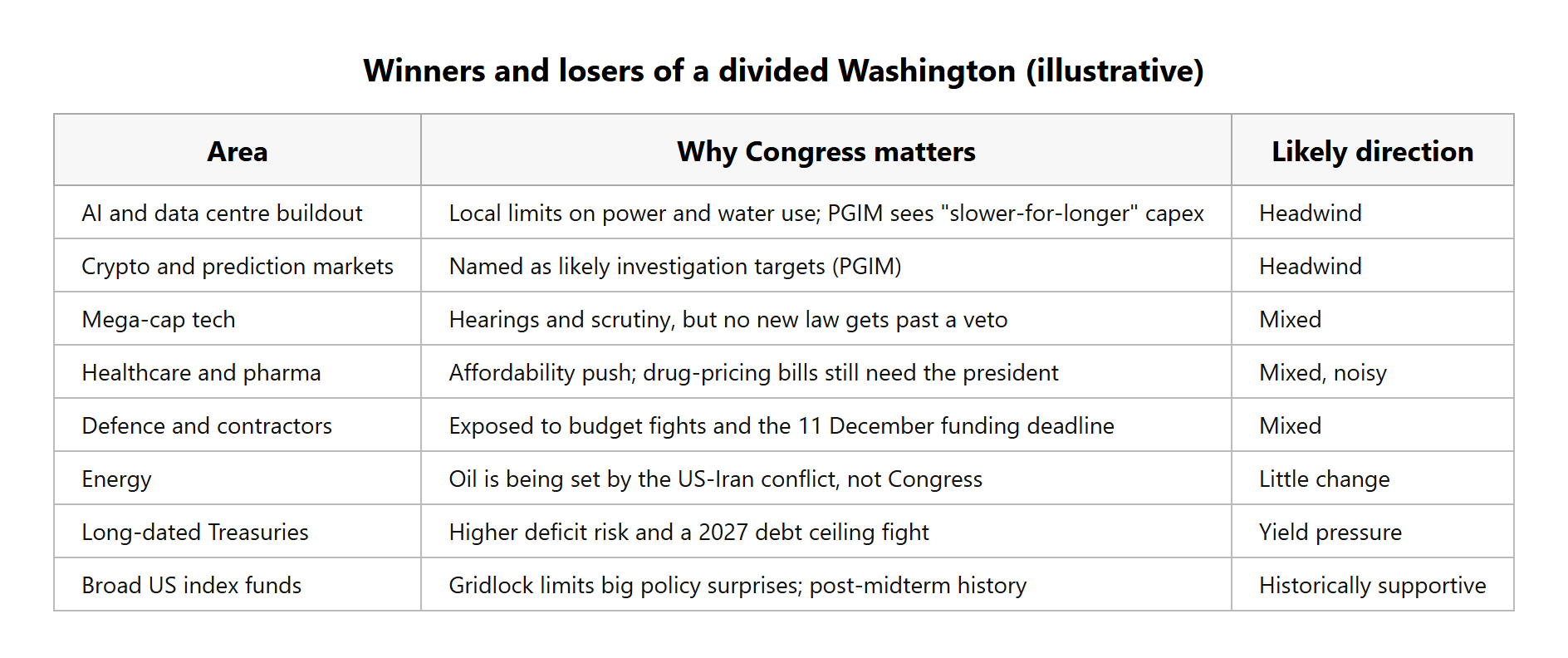
The table above is an illustrative framework, not a forecast. Most large companies sit in the middle column, where the effect depends on what Congress actually does rather than what it can threaten.
The clearest pressure point is the AI buildout. Data centres became a campaign issue this year over power bills and water use, and an ICICI Bank note estimated that the toss-up states where Republicans could lose hold about 15% of US data centre capacity. In Texas, voters rejected a data-centre-friendly agenda. PGIM's view is that split government brings moderate limits that slow AI spending without stopping it, a "slower-for-longer" cycle. It is one likely reason Nasdaq futures fell roughly twice as hard as the Dow overnight.
Healthcare and pharma are noisy rather than clearly hurt. Democrats campaigned hard on affordability, so expect drug-pricing hearings and bills. Expect also that most of those bills will not get past the president's desk. Defence and government contractors are exposed to the budget fight more than to any change in policy, because a shutdown delays payments and new contracts.
Energy is the sector Congress matters least to right now. The oil price is being set by the US-Iran conflict, not by a vote in Washington.
🌏 What this means if you are investing from India
Three things are worth thinking through if you hold US stocks from India.
The first is your sector mix. Many Indian portfolios lean heavily towards US technology, and specifically the AI names that have led the market for two years. That is the part of the market with the most direct exposure to a Congress that wants to slow data centre growth. If most of your US money sits in a handful of AI-linked stocks, last night's futures move is a preview of the kind of headline risk you are carrying.
The second is the dollar and yields. Fights over funding and the debt ceiling put upward pressure on long-term Treasury yields, which already touched multi-year highs above 5% this autumn. A higher US yield tends to support the dollar. The rupee spent much of September and October near record lows, around 95 to 96 per dollar per Trading Economics reporting, with expensive oil adding to the pressure. For an Indian holder of US stocks, a firm dollar cushions rupee returns. Here is the plain maths: if your US stock falls 5% in dollars but the dollar rises 3% against the rupee, you are down roughly 2% in rupee terms, not 5%.
The third is trade policy, and it cuts two ways. Because tariffs stay in the president's hands, a Democratic Congress does not by itself lower the tariffs that affect Indian exporters. If PGIM is right that the White House leans further on executive action, tariff uncertainty could rise. That would be a headwind for Indian goods exporters, while Indian IT services, which are not covered by goods tariffs, are more exposed to US corporate tech budgets than to trade policy.
🔭 What to watch over the next few weeks
The final count comes first. Several House races and at least one Senate seat were still being counted overnight. A Senate majority of exactly 51 is a thin margin, so check the final tally before reading too much into the size of the win.
Mark 11 December on your calendar. That is when the current government funding expires, per ICICI Bank. Watch for whether the outgoing Congress passes a full-year bill, another short extension or nothing at all. The same lame-duck session is the window to raise the debt ceiling before it becomes a 2027 fight.
The Fed meets on 8 and 9 December, with fresh projections. On 28 October it held rates at 3.75% to 4.00% in a 10 to 2 vote, with two officials preferring a hike, and futures markets lean towards a December hike. A shutdown that delays the November jobs or inflation data would leave the Fed deciding with less information than usual. Separately, a Democratic Senate now has to confirm any new Fed governors, which PGIM describes as added protection for the Fed's independence.
Finally, watch the AI capex lines on earnings calls. If the large cloud companies start trimming data centre spending plans or naming permitting and power as a constraint, the political pressure is reaching the numbers.
If this changed how you see the midterm results, pass it on.
📊 The bottom line
A divided government does not change the direction of US policy overnight. Tariffs, the Iran conflict and the Fed will still matter more to your returns than any single bill. What it changes is the calendar: a funding deadline on 11 December, a Fed meeting in the same week, and a debt ceiling fight likely next summer. History says stocks have tended to do well in the year after a midterm, but last night's move shows where the pain lands first, in AI-heavy portfolios. Check how concentrated your US holdings are in the AI buildout, and decide whether you are comfortable carrying that headline risk into a busy December.
📈 Numbers worth remembering
This article is for educational purposes only and does not constitute investment advice. Winvesta India Technologies Ltd. does not guarantee the accuracy of third-party data cited above. Past performance is not indicative of future returns. Please consult a registered financial adviser before making investment decisions.