


The old way to own defence was to buy a prime contractor and forget about it for a decade, because the budget only ever went up. That still works, but it is no longer what you are being paid for. With the Strait of Hormuz shut and Tehran publishing six conditions to reopen it, defence funds now carry a war premium on top of a procurement cycle, and those two things behave very differently when a deal gets signed. That's why we built Winvesta Crisps, to decode what's actually moving the funds you own, in plain language, before the consensus catches up. 60,000+ investors from all over India are already in. What about you?
🔔 Add winvestacrisps@substack.com to your email list so our updates never land in spam.
Most investors looking at a defence ETF right now see a war and assume the trade is obvious. The order books say they are half right. The US House has advanced a fiscal 2027 defence authorisation worth a record $1.15 trillion, NATO has set a target of 5% of GDP by 2035 with Poland, the Baltics and Greece already running above 4%, and Rheinmetall's backlog passed €80 billion after its July results, per company reporting. None of that depends on Iran. What does depend on Iran is the last leg of the move. Brent was around $84.6 a barrel for October delivery on Monday, up roughly 3% on the day, with WTI near $79.0, per Al Jazeera and UPI. That is a long way below the peak above $140 earlier this year, which tells you the market is already pricing a partial resolution. Tehran's six conditions for reopening the strait, which run from ending hostilities to war reparations, sanctions relief and unfreezing assets, are the timetable your defence position is actually trading on.
🎯 Meet Nikhil
Nikhil, 34, product manager at a SaaS firm, Pune. Portfolio: ₹52 lakhs across US markets. He bought his first defence ETF in March, three weeks after the strait shut, because the logic felt airtight. Wars need weapons. Weapons need contractors. He put roughly 11% of his US book into it and has not looked at the holdings since.
Here is what Nikhil thinks he owns: a basket of missile and fighter jet makers that gets paid when there is conflict.
Here is what he actually owns. His fund is ITA, and its single largest position is GE Aerospace at around 21% of the fund, with RTX near 15% and Boeing near 9%, per iShares holdings data. GE Aerospace makes jet engines, and a large share of that business is commercial aviation and aftermarket servicing, not munitions. Boeing's defence unit is a minority of Boeing. Nikhil's "war basket" has close to half its weight in three companies whose fortunes are tied at least as much to airline fleet renewal and travel demand as to the Pentagon.
His second problem is one he has not priced at all. Reporting in June, when an Iran peace deal briefly looked close, described defence names falling by around 20% from their highs before recovering. Nikhil's ₹5.7 lakh position moving 20% is a ₹1.1 lakh swing, triggered not by anything going wrong in the world but by something going right. That is an unusual risk to carry without knowing you are carrying it.
📊 What the four defence funds actually give you
Start with the flows, because they set the crowding question. A note before the table: flow figures vary by data provider and reporting window, so treat direction as the signal and magnitude as an estimate.
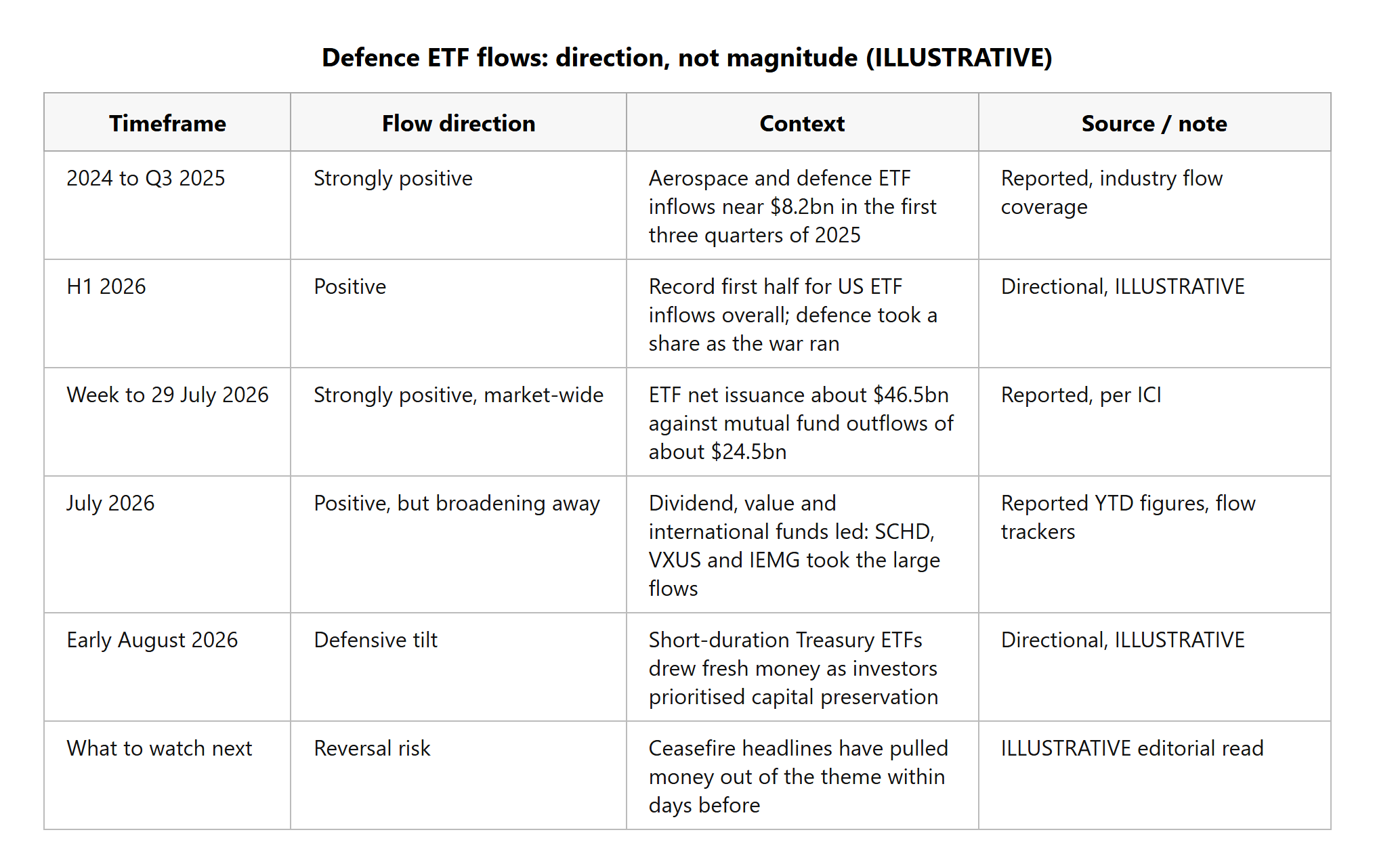
The pattern worth sitting with is the last two rows. Money in July went disproportionately to dividend, value and international funds rather than into more US risk, and early August saw fresh money move into short-duration Treasury ETFs as investors prioritised capital preservation. Defence is running hard, but it is not currently the crowd's favourite trade. That is a mildly good thing for anyone buying today, and a mildly bad thing for anyone hoping retail flows carry it higher from here.
Now the funds themselves, because "defence ETF" describes four quite different portfolios.
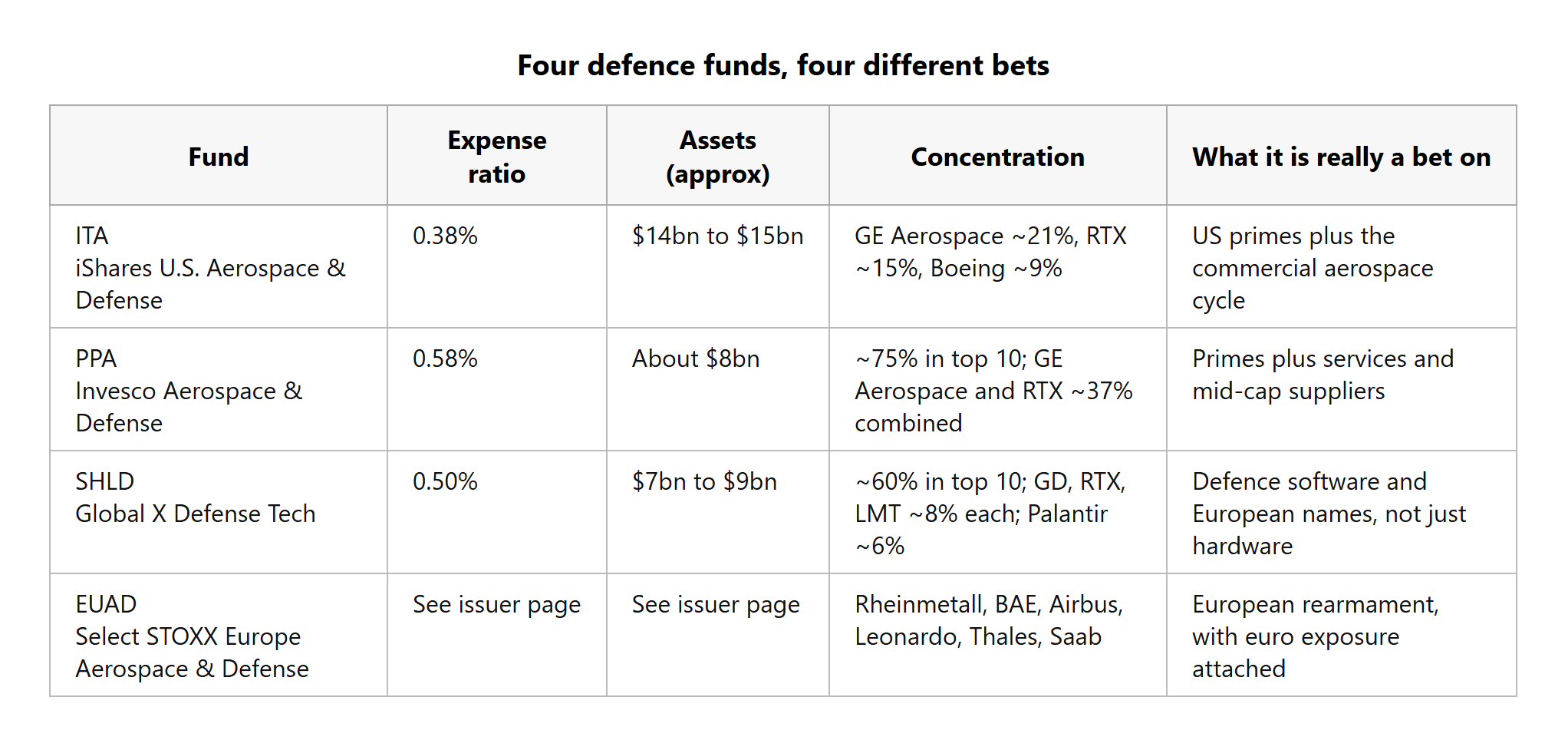
A fourth option sits outside that table. EUAD, the Select STOXX Europe Aerospace & Defense ETF, holds the continental names: Rheinmetall, BAE Systems, Airbus, Leonardo, Thales, Saab, Hensoldt and Dassault. It ran roughly 75% in 2025 on the rearmament story, then spent much of the first half of 2026 giving some of that back before recovering, per market reporting. Its logic is the cleanest of the four, because European rearmament is a budget commitment written into national plans rather than a response to one strait. It is also the one with currency risk layered on top for a rupee-based investor.
One number cuts through all of this for an Indian reader. Lockheed Martin trades at roughly 17 times forward earnings, cheaper than the S&P 500. Indian defence PSUs mostly trade between 35 and 50 times trailing earnings, with HAL near 36 times and Bharat Dynamics near 105 times, per Indian broker coverage. India's FY27 budget put ₹7.85 lakh crore into defence with about ₹2.19 lakh crore of capital spending and 75% earmarked for domestic procurement, so the demand is real. You are still paying roughly double the multiple for it.
🚀 Want to add ITA, PPA or SHLD to your portfolio? Trade them directly from India on the Winvesta app. No US bank account needed! Join 60,000+ investors, become a paying subscriber or download the Winvesta app and fund your account to get insights like this for free!