


Five years ago, analysing CrowdStrike meant counting endpoints and asking whether Microsoft would eventually bundle the product away for free. Not anymore. In the quarter it reported on 26 August 2026, CrowdStrike added a record $332.8 million of net new annual recurring revenue, up 51% year-over-year, and raised its full-year outlook for the second quarter running. Most of that growth is now sold through a single pooled contract that did not exist three years ago. That's why we built Winvesta Crisps, to decode what's actually driving the companies you own, in plain language, before the consensus catches up. 60,000+ investors from all over India are already in. What about you?
🔔 Don't miss out!
Add winvestacrisps@substack.com to your email list so our updates never land in spam.
Most investors still think of CrowdStrike as the endpoint security company that broke 8.5 million Windows machines in July 2024. That framing is accurate and dangerously incomplete. Total revenue in the quarter ended 31 July 2026 was $1.47 billion, up 26%, annual recurring revenue reached $5.84 billion, up 25%, and free cash flow hit a second-quarter record of $377.4 million, per CrowdStrike's Q2 FY2027 earnings release. The company also flipped the outage from a cost line to a recovery: the July 19 Incident and related matters produced a net credit of $14.5 million in the quarter, against a $35.7 million charge in the same quarter last year. The interesting number is none of those. It is $2.29 billion, and it sits inside a licensing construct called Falcon Flex.
🏭 What CrowdStrike actually is today
CrowdStrike sells one lightweight sensor that installs on a device and reports into one cloud platform. Everything else the company sells is a software module switched on against that same sensor and that same data: endpoint detection, identity protection, cloud workload security, exposure management, next-generation SIEM, and a managed detection service where CrowdStrike analysts do the hunting for you.
The financial statements barely reflect any of this. CrowdStrike reports exactly two revenue lines, subscription and professional services, and does not break out revenue or ARR by module. What it discloses instead is how many modules each customer runs. As of 31 July 2026, 51% of subscription customers ran six or more modules, 35% ran seven or more, and 26% ran eight or more, per the Q2 FY2027 release. Six months earlier those figures were 50%, 34% and 24%. The platform is widening steadily, one module at a time, and the module count is the closest thing shareholders get to a segment disclosure.
What has changed fastest is the shape of the product line rather than the sensor. Over the past year CrowdStrike has bought its way into the AI security stack. Pangea brought prompt-layer protection, which became Falcon AI Detection and Response. Onum brought telemetry pipeline management and Seraphic brought browser runtime security. The largest of them was SGNL, an identity company bought for about $740 million, which now ships as Continuous Identity for AI Agents. Goodwill on the balance sheet grew from $1.36 billion at the January year-end to $2.25 billion by 31 July, and the cash flow statement shows $881.4 million spent on business acquisitions in the first half, per the Q2 FY2027 release. In the same quarter the company agreed to acquire the technology assets of XM Cyber from Schwarz Digits.
Chief executive George Kurtz gave the strategy its own label in the results release, describing "the Mythos moment" as the point at which the market accepted that AI adoption needs security. His framing is that every enterprise will run on AI, and that securing it is the largest market opportunity in the company's history. Whether or not you buy the branding, the product roadmap has followed it exactly.
🧩 Segment breakdown
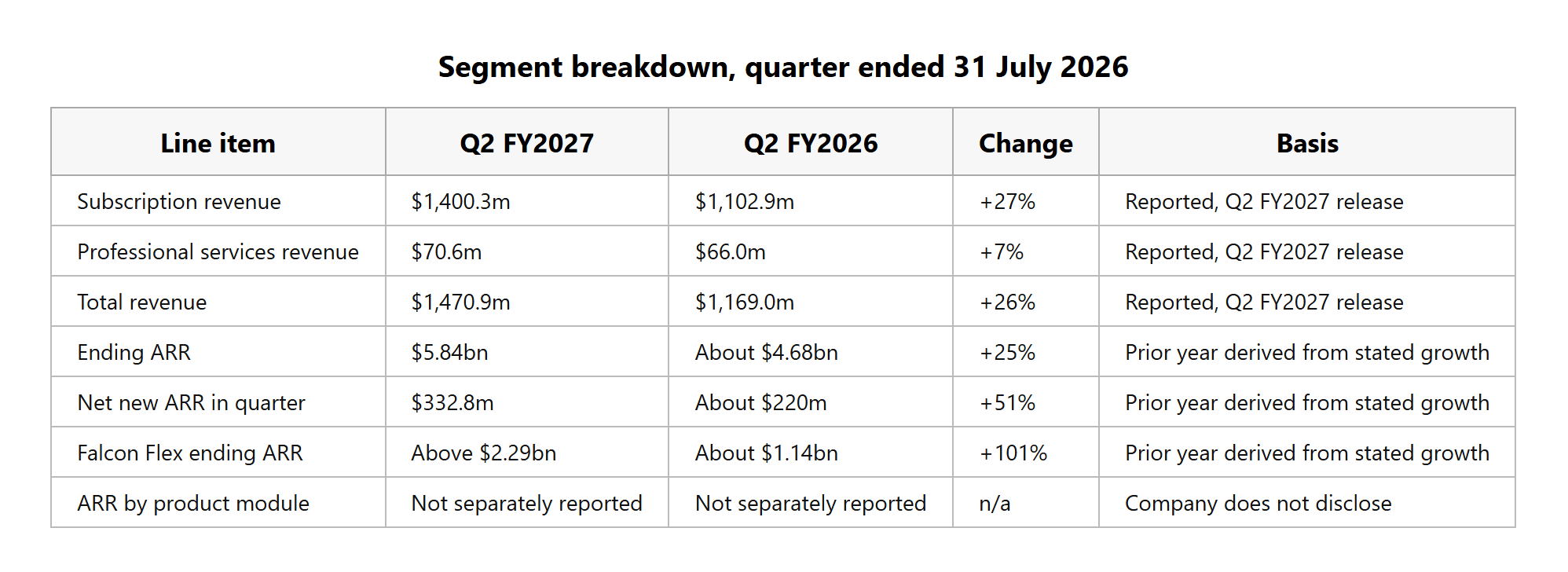
Two things in that table carry the argument. Subscription revenue is 95% of the total and grew 27%, while professional services grew 7%. This is a software business with a small consulting arm attached, not a services business, and the mix is getting purer.
The second is the row that says nothing. CrowdStrike does not report ARR by module, so nobody outside the company can tell you how much of that $5.84 billion is endpoint, how much is cloud, and how much is the identity and AI security work the acquisitions were meant to seed. Analysts model it; the company does not print it. That matters more than usual here, because the growth story has moved to products that are two years old at most.
⚡ Falcon Flex: the core strategic bet
Falcon Flex changes what a customer buys. Instead of purchasing a fixed number of seats of a fixed set of modules, the customer commits a pooled dollar amount across a multi-year term. They then draw that budget down across the whole portfolio, reallocating between endpoint, identity, cloud and SIEM as priorities move. There is no published rate card. Every Flex deal is negotiated.
The cohort has grown quickly. Ending ARR from accounts that have adopted Falcon Flex passed $2.29 billion as of 31 July 2026, up more than 101% year-over-year, per the Q2 FY2027 release. At the January year-end that figure was $1.69 billion, up more than 120%, per the Q4 FY2026 release. Against total ARR of $5.84 billion, Flex accounts now represent roughly 39% of the company's recurring revenue base.