



Owning Cisco as a dividend stock and tuning it out for the rest of the year may have worked. Not anymore. The market had Cisco filed under “legacy networking” while the company was quietly designing its own AI chips, locking in billion-dollar hyperscaler orders, and integrating a $28 billion cybersecurity platform. That is exactly the kind of slow-build transformation that never shows up in the headlines until the stock has already moved.
That’s why we built Winvesta Crisps, to surface the companies whose story has fundamentally changed before the market finishes repricing them. 60,000+ investors from all over India are already in. What about you?
🔔 Don’t miss out!
Add winvestacrisps@substack.com to your email list so our updates never land in spam.
Most investors still think of Cisco as the company that made the router sitting in the office closet. That framing is roughly 20 years stale. Cisco just reported record Q3 FY2026 revenue of $15.8 billion, up 12% year-over-year, per the company’s earnings release. AI infrastructure orders from hyperscalers hit $5.3 billion year-to-date, surpassing the company’s own full-year target with a quarter still to go, per the earnings transcript.
Management promptly raised full-year AI order guidance from around $5 billion to roughly $9 billion, and CEO Chuck Robbins went on CNBC and used the words “networking supercycle.” The stock jumped around 15% the next day. That is not what happens to a legacy tech company running out of road. That is what happens when a company that the market had written off turns out to be building exactly what the AI era needs.
🔥 Top movers
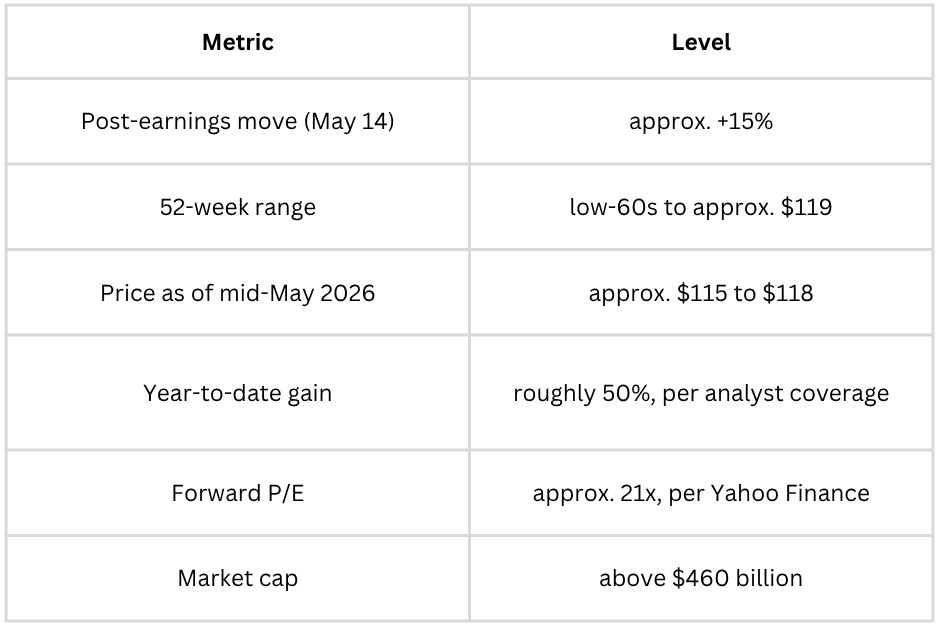
Note: CSCO jumped roughly 15% on May 14, 2026, the day after Q3 FY2026 earnings, per CNBC, marking one of the largest single-day moves for the stock in recent years. The 52-week range runs from the low-60s to around $119, with shares trading near the top of that range as of mid-May 2026, per Yahoo Finance. Year-to-date gains stand at roughly 50%, per analyst coverage, as the AI infrastructure order story has progressively re-rated the stock from dividend stalwart to networking infrastructure play.
🏗️ Not one company, but four
Most coverage of Cisco leads with the headline revenue number and stops there. That misses how differently the four segments inside the business actually behave.
Networking is where the AI story lives right now. This segment, which covers data centre switching, campus switching, enterprise routing, wireless, and industrial IoT, generated $8.8 billion in Q3 and grew 25% year-over-year, per the earnings transcript. Robbins told analysts on the call that networking orders surged 50% in the quarter, driven by triple-digit growth in service provider routing and compute, and double-digit growth across every other sub-category. Data centre switching orders alone climbed more than 40% year-over-year, per company commentary.
Security is the segment built around the $28 billion Splunk acquisition that closed in March 2024. This is Cisco’s bet on becoming the operating system for enterprise cybersecurity and observability. Revenue came in at around $2 billion in Q3, roughly flat year-over-year, per earnings commentary. The drag is structural and expected: existing Splunk customers are migrating from on-premises licences to cloud subscriptions, which compresses near-term revenue recognition while simultaneously building a more durable, recurring revenue base. Robbins said Cisco is tracking ahead of its goal of adding around 1,000 new Splunk customer logos in FY26, per SDxCentral.
Collaboration covers Webex, video conferencing, and unified communications. It is the smallest contributor to growth in the current cycle, but it generates steady cash flow.
Services bring in around $3.7 billion per quarter and cover software support, managed services, and the subscription layer across the product portfolio. Services revenue dipped slightly year-over-year in Q3 due to the timing of contract start dates, per company commentary, but the recurring revenue mix has been improving as the Splunk cloud transition matures. Cisco has now surpassed its long-standing goal of generating more than half of revenue from software and services, a target originally set several years ago, per the company’s investor presentation.
🤖 The AI supercycle bet
The networking supercycle Robbins described is not a marketing line. It has a specific structural explanation, and Cisco sits at a crucial intersection of it.
Silicon One: Building the chip, not just the box
The most underappreciated part of Cisco’s AI positioning is that it is a chip designer, not just a systems assembler. Silicon One is Cisco’s proprietary unified networking architecture, introduced in 2019, that powers both routing and switching products across hyperscaler, data centre, service provider, and enterprise use cases, per company disclosures. The latest generation, the Silicon One G300, was announced in February 2026 at Cisco Live EMEA in Amsterdam and delivers 102.4 terabits per second of switching capacity, per the company’s announcement. The G300 was designed specifically for gigawatt-scale AI clusters, with liquid-cooling options that significantly improve energy efficiency compared to air-cooled alternatives, per Cisco’s press release.
The in-house silicon strategy matters for two reasons. First, it means Cisco is less dependent on third-party chip suppliers than competitors, which rely entirely on Broadcom merchant silicon, giving it more supply chain control and tighter AI hardware markets. Second, it allows Cisco to optimise the full stack, silicon, systems, and software, in ways that pure-software companies or pure-hardware assemblers cannot.
Per Cisco’s investor materials, Microsoft publicly stated that Silicon One’s common architecture has simplified its ability to expand deployments from initial data centre use cases to wide-area network and AI workloads. That is the kind of enterprise-level validation that moves procurement conversations.
The Ethernet vs InfiniBand shift
For years, the most demanding AI training clusters ran on InfiniBand, a proprietary high-performance interconnect technology largely controlled by Nvidia since its acquisition of Mellanox. Ethernet was considered slower and less suited to the synchronised, east-west data flows generated by GPU clusters. That assumption is changing rapidly.
Ethernet has caught up technically through advances in congestion management and lossless transport protocols, per industry analysis from the Dell’Oro Group cited by Network World. More importantly, hyperscalers are now actively preferring multi-vendor, open-standard Ethernet for new deployments because it avoids vendor lock-in and integrates with existing enterprise infrastructure. Cisco’s Silicon One architecture is squarely aligned with this trend, with systems designed to compete for the back-end AI fabric in the largest clusters, not just the enterprise edge.
The order data backs this up. Hyperscaler AI orders went from around $600 million in Q3 FY2025 to $1.9 billion in Q3 FY2026, roughly tripling year-over-year, per the earnings transcript. Year-to-date, they have already hit $5.3 billion, and management has now guided the full year to roughly $9 billion, four times the prior full-year guidance, per the company’s earnings release and subsequent analyst coverage.
The campus refresh cycle
Less dramatic but equally important is the multi-year refresh of enterprise campus networks. The Wi-Fi 6 and Wi-Fi 7 upgrade cycle, combined with AI-driven demand for higher bandwidth at the network edge, is driving replacement orders across Cisco’s campus switching and wireless portfolios. Campus switching and wireless both grew double digits year-over-year in Q3, per the earnings transcript. This cycle tends to be long, sticky, and high-margin once it starts, since most enterprise IT departments standardise on a single vendor for a full campus deployment and do not switch mid-cycle.
Want to add Cisco to your portfolio? Trade $CSCO directly from India on the Winvesta app. No US bank account needed!
🚀 Join 60,000+ investors, become a paying subscriber or download the Winvesta app and fund your account to get insights like this for free!
💰 Financial performance

The figures below are drawn from Q3 FY2026 reported results and full-year FY2026 guidance, as reported in Cisco’s earnings release on May 13, 2026.
Q3 FY2026 results: