


Five years ago, analysing Cisco meant tracking enterprise refresh cycles and asking whether the router business had any growth left in it. Not anymore. Cisco closed fiscal 2026 with $9.3 billion of AI infrastructure orders from hyperscalers, roughly four and a half times the prior year, and guided fiscal 2027 revenue to about $72.8 billion at the midpoint, comfortably ahead of what the Street had modelled. The shares fell anyway, on a gross margin forecast a percentage point below the quarter it reported in the same release. That is why we built Winvesta Crisps, to decode what's actually driving the companies you own, in plain language, before the consensus catches up. 60,000+ investors from all over India are already in. What about you?
🔔 Don't miss out!
Add winvestacrisps@substack.com to your email list so our updates never land in spam.
Most investors still think of Cisco as the company that sells the boxes corporate networks run on. That framing is accurate and dangerously incomplete. In the fourth quarter it reported on 12 August 2026, product revenue grew 24% year-over-year to $13.5 billion while services revenue stayed flat, total product orders rose 35%, and networking product orders rose 40%, per Cisco's Q4 fiscal 2026 earnings release. The shares then fell about 4.7% in after-hours trading to around $118. The number that moved them was not an order figure. It was a gross margin forecast of 65% to 66% for the first quarter of fiscal 2027, against the 66.3% Cisco had just delivered. Investors have stopped asking whether Cisco can win AI infrastructure work. They have started pricing what winning it costs.
🏭 What Cisco actually is today
Cisco reports four product categories plus services, and the proportions explain both the quarter and the reaction to it.
Networking is the business, at $34.7 billion of fiscal 2026 revenue, up 22%, per the earnings release. That is 55% of the company. It spans campus switching and routing for enterprises, the optics and systems that carry traffic between data centres, and Cisco's own switching silicon. Everything the market now calls Cisco's AI story lands inside this line, alongside a corporate networking business that has been posting double-digit order growth for eight consecutive quarters.
Security is $8.2 billion and grew 2%. That number looks like stagnation and is better read as accounting. Cisco is moving Splunk, which it bought in 2024, off perpetual on-premises licences and onto cloud subscriptions that recognise revenue over the contract rather than up front. Management has said Splunk's recurring revenue and contracted backlog both grew at double-digit rates through the year even as reported segment revenue sat still.
Collaboration, at $4.3 billion and up 4%, is Webex and meeting-room hardware. Observability, at $1.1 billion and up 4%, is the smallest line. Services, at $15.0 billion, is support contracts and professional work, and it is the ballast: revenue that arrives whether or not anyone buys a new switch this quarter.
Underneath the segments sits the part of Cisco that rarely makes headlines. Annualised recurring revenue finished the year at $32.1 billion, up 3%, with product recurring revenue up 5%. Subscriptions were 48% of total revenue. Remaining performance obligations, which is contracted revenue not yet recognised, stood at $46.7 billion, up 7%, per the Q4 fiscal 2026 earnings materials. Nearly half of Cisco's revenue is now contractual before the year begins.
🧩 Segment breakdown
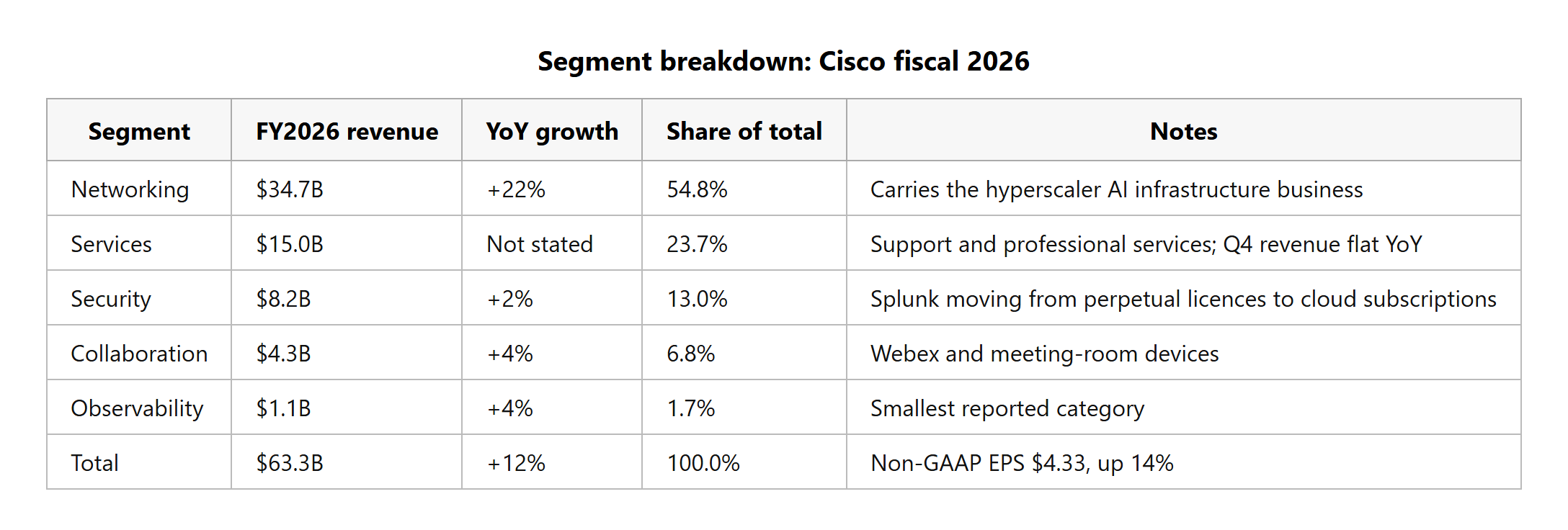
Two rows in that table carry the argument. Networking added roughly $6.3 billion of revenue in a single year, which is more than the entire Collaboration and Observability segments combined. That is where the AI money is going, and it is the most hardware-intensive line Cisco sells.
Security is the counterweight. At $8.2 billion and 2% growth, the segment Cisco spent $28 billion acquiring Splunk to build is not yet contributing growth at the revenue line. The recurring metrics say the transition is working. The reported figures say it is not finished.
🤖 The hyperscaler bet, and what it costs
Cisco spent two decades selling to enterprises and governments. The bet that defined fiscal 2026 was selling to the handful of companies building AI data centres instead.
It worked. Hyperscaler AI infrastructure orders were $4 billion in the fourth quarter alone and $9.3 billion for the full year, about four and a half times the prior year, per the earnings release. Cisco had entered the year guiding to roughly $5 billion of such orders and raised that target through the year as demand arrived faster than planned.
The detail that matters more is what happened outside those customers. Total product orders grew 35% in the quarter, and 25% excluding hyperscalers. Cisco also booked more than $1 billion of AI infrastructure orders during the year from neocloud providers, sovereign cloud projects and ordinary enterprises, a stream it reports separately from the hyperscaler figure. The AI build-out is not cannibalising the enterprise business, and enterprises are ordering more networking gear because they are wiring their own AI capacity. Both engines are running.