


Samsung’s HBM4 chip deal with Nvidia sent semiconductor ETFs soaring, pulling in $8.2 billion this month alone. If you own SOXX, SMH, or even just QQQ, you’ve probably been feeling pretty smart lately.
But here’s the thing about everyone feeling smart at the same time: it usually doesn’t end well.
The real question isn’t whether AI chips are the future—they obviously are. It’s whether you’re early to a decade-long trend or late to a crowded trade that’s about to hit turbulence. And right now, the data is flashing some uncomfortable warning signs.
Let’s figure out which side you’re on.
🎯 First, let’s see if you’re actually Sarah
Sarah, 42, software engineer, $180k portfolio
She’s been building positions thoughtfully for the past year. She reads financial news, diversifies across “different” ETFs, and considers herself a disciplined long-term investor. Here’s what she owns:
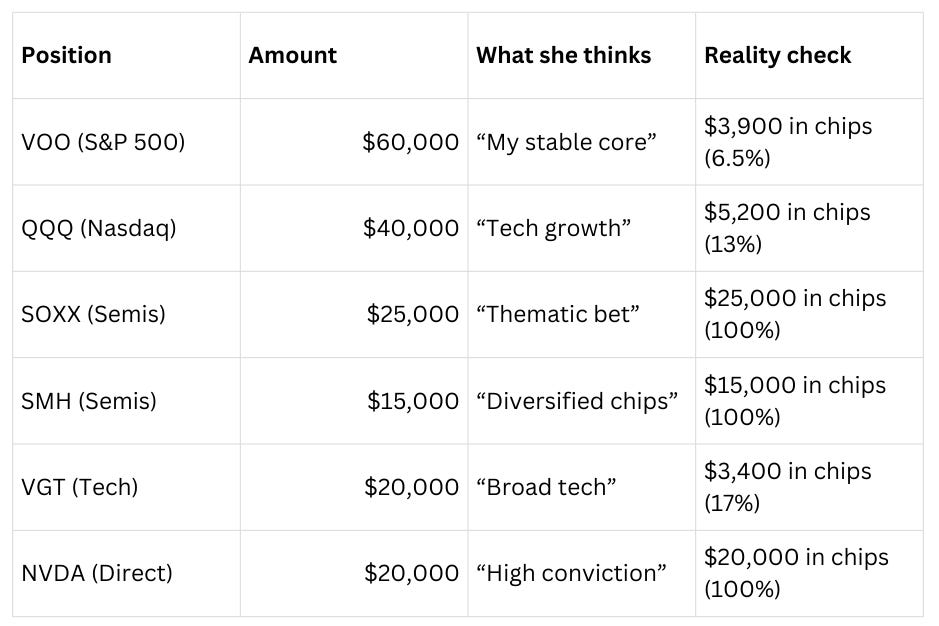
Sarah thinks: “I’m diversified across six different investments.”
Sarah actually has: $72,500 in semiconductors = 40.3% of her portfolio
And it gets worse. When you look at what’s inside those ETFs:
Nvidia alone: $14,800 (8.2% of total portfolio)
Broadcom: $6,900 (3.8%)
Taiwan Semi: $8,100 (4.5%)
AMD: $4,600 (2.6%)
She doesn’t own six different things. She owns the same 10 stocks six different times.

What happened to Sarah in March 2024:
When semiconductor ETFs dropped 12% on export restriction headlines (not even a real crisis, just policy noise), Sarah’s “diversified” portfolio fell 5% in two weeks. Her supposedly safe S&P 500 fund, her Nasdaq position, her tech fund—everything dropped at once because everything was secretly the same bet.
Are you Sarah? Keep reading.
📊 Quick primer: What ETF flows actually tell you
Simple version: When people put new money into an ETF (not just the price going up), that’s a “flow.” It measures real buying activity, not just enthusiasm.
Why it matters: Flows predict future performance better than price alone. Heavy inflows during good news = investors putting money where their mouth is. Heavy inflows during all-time highs = possible late-stage FOMO.
Current situation (based on recent flow data):
Semiconductor ETFs: +$4.2B (several times normal monthly volume)
Broader tech ETFs: +$1.4B (moderately elevated)
S&P 500 ETFs: +$2.1B (roughly normal)
The gap between those numbers tells you investors aren’t just “buying the market”—they’re making a very specific bet on semiconductors. And a large portion of them are betting on the exact same 10 stocks.
Historical parallel: In early 2000, tech funds saw extreme inflows while trading at all-time highs. Within months, the Nasdaq peaked and began a 78% decline over the next two years. (No, we’re not predicting that. But the pattern—peak prices + peak inflows + peak optimism—rhymes uncomfortably.)