


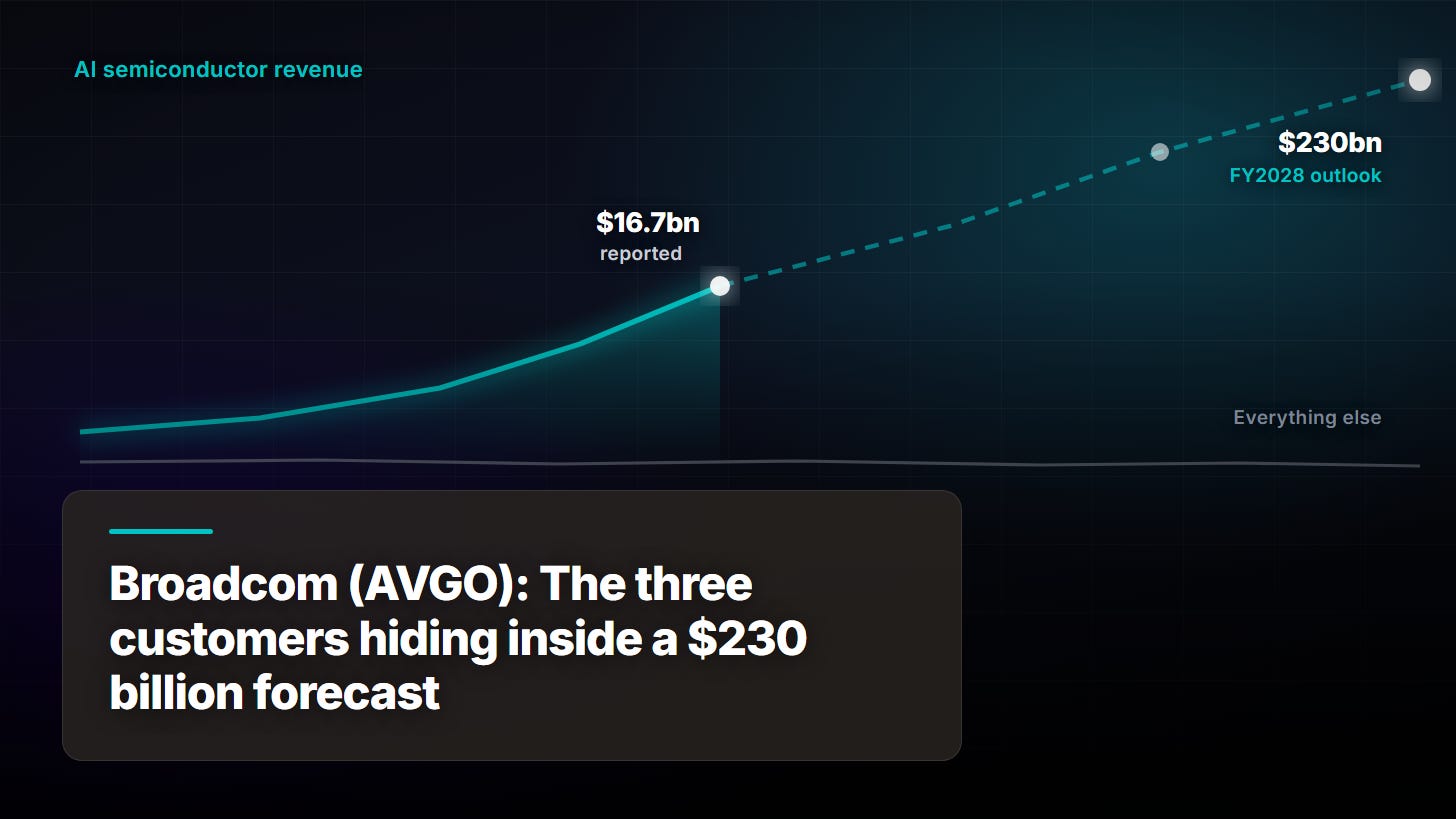
Four months ago the bull case for Broadcom rested on a $100 billion AI chip target. Management has since more than doubled it. On 2 September 2026 the company reported $16.7 billion of AI semiconductor revenue in a single quarter, up 221% year-over-year, and told investors to expect roughly $230 billion of AI revenue in fiscal 2028. The shares fell. That gap between the numbers and the reaction is the whole story. That's why we built Winvesta Crisps, to decode what's actually driving the companies you own, in plain language, before the consensus catches up. 60,000+ investors from all over India are already in. What about you?
🔔 Don't miss out!
Add winvestacrisps@substack.com to your email list so our updates never land in spam.
Most investors still think of Broadcom as a diversified chip and software conglomerate that happens to sell AI networking gear. That framing is accurate and dangerously incomplete. In the quarter ended 2 August 2026 and reported on 2 September, revenue was $29.591 billion, up 86% year-over-year from $15.952 billion, non-GAAP operating income was $20.1 billion or 68% of revenue, and free cash flow was $13.7 billion or 46% of revenue, per Broadcom's Q3 FY2026 earnings release. Guidance for the fourth quarter is roughly $34.8 billion, up 93%. None of those is the number that matters. The number that matters is $230 billion, which is what chief executive Hock Tan told analysts on the call to expect from AI semiconductors alone in fiscal 2028, and which rests on a customer list you can count on one hand.
🏭 What Broadcom actually is today
Broadcom reports two segments. Semiconductor Solutions was $20.839 billion in the quarter, 70% of revenue and up 127%. Infrastructure Software was $8.752 billion, 30% of revenue and up 29%, per the Q3 FY2026 release.
Inside the semiconductor half, one disclosed line carries almost all of the growth. AI semiconductor revenue was $16.7 billion, up 221% year-over-year and 54% sequentially, which is 56% of the entire company. It splits into two products. The first is the XPU, a custom accelerator that Broadcom co-designs with a single customer: the customer owns the architecture and decides what the chip is optimised for, while Broadcom supplies the high-speed interconnect blocks, the packaging, the physical design and the relationship with the foundry. The second is networking silicon, the Tomahawk switch and Jericho router families and the optical and PCIe components that move data between accelerators. On the Q3 call management said XPU shipments rose more than 3.5 times year-over-year and made up 73% of AI revenue, which is a meaningful shift: two years ago networking was the larger half.
The software half is VMware plus the mainframe and security assets Broadcom has accumulated, and it is run for cash rather than growth. Management put infrastructure software operating margin at 84% in the quarter, up about 650 basis points year-over-year, per commentary on the earnings call. It is the ballast. It pays the dividend and services the debt while the semiconductor side absorbs the volatility.
Everything else is a rounding error in the narrative, though not in the accounts. Subtract the disclosed AI figure from segment revenue and roughly $4.1 billion of non-AI semiconductor revenue is left: broadband, wireless components, enterprise storage and industrial. Broadcom does not report growth for that residual separately, so treat the $4.1 billion as an implied figure rather than a printed one. It has not grown meaningfully in two years, and nobody is buying the stock for it.
🧩 Segment breakdown
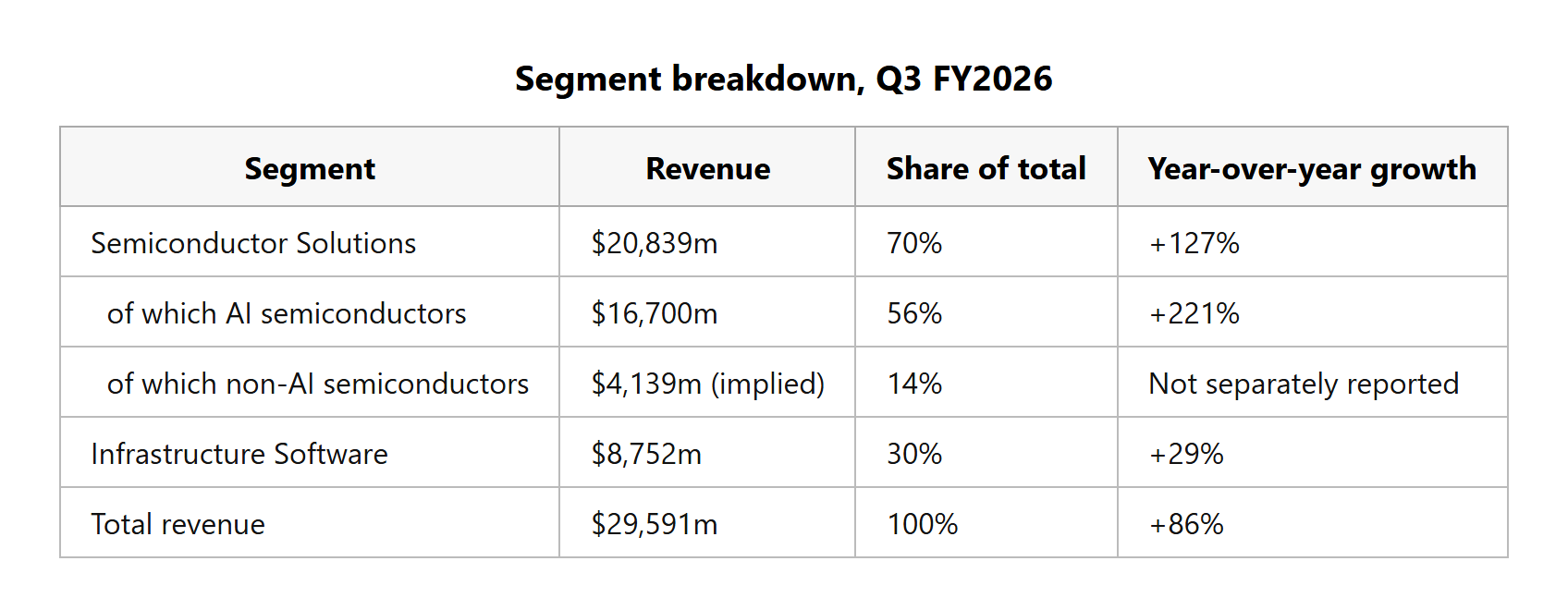
Two rows in that table carry the argument. AI semiconductors at $16.7 billion are now larger than the whole company was in the same quarter last year, when total revenue was $15.952 billion. A business that grew 221% year-over-year became the majority of a $1.75 trillion company in about eight quarters.
The second is the row the company does not print. Broadcom discloses AI semiconductor revenue as a single number and does not break it down by customer, by XPU programme, or between accelerators and networking beyond the percentage management chooses to mention on a call. For a business where three customers plausibly account for most of the total, that is the disclosure gap that should bother shareholders most. Everything an investor knows about concentration here comes from management commentary and analyst estimates, not from a reported segment line.
⚡ Custom silicon at gigawatt scale: the core strategic bet
The bet is that the largest AI workloads stop being general-purpose. A merchant GPU has to be good at training, inference, graphics and scientific computing, and the customer pays a gross margin in the mid seventies for that flexibility. Once a company is running one model architecture at enormous volume, the calculation changes: a chip designed for exactly that workload can deliver better performance per watt and per dollar, and the customer keeps the margin that would otherwise go to Nvidia. Broadcom sells the ability to build that chip.
What makes this quarter different from the last four is that the commitments have moved from slideware to contracted gigawatts. Google remains the anchor, with a long-term TPU agreement management has described as worth multiple tens of billions of dollars annually. Anthropic expanded its partnership with Google and Broadcom to cover what Anthropic itself describes as multiple gigawatts of next-generation TPU capacity coming online from 2027, with press reports citing Broadcom's disclosure putting the figure at about 3.5 gigawatts. OpenAI and Broadcom announced a 10 gigawatt programme of OpenAI-designed accelerators deploying from the second half of 2026 through the end of 2029, whose first chip, an inference processor called Jalapeño, is targeted for initial deployment by the end of this year. Meta's MTIA accelerator is expected to reach production shipments in the fourth quarter, per management commentary.