



Analyzing Blackstone meant tracking buyout multiples, exit timing on leveraged deals, and how much debt sat on portfolio companies. Not anymore. Private equity is now the smallest of Blackstone’s four business lines. Credit, insurance capital, and a fast-growing real assets book do most of the work today, and a striking share of that capital is now flowing straight into the data centers and power plants the AI economy needs to run. This piece unpacks how a leveraged buyout shop turned into something closer to the banker behind the AI infrastructure boom. That’s why we built Winvesta Crisps, to break down what’s actually driving the companies you own, in plain language, before the consensus catches up. 60,000+ investors from all over India are already in. What about you?
🔔 Don’t miss out!
Add winvestacrisps@substack.com to your email list so our updates never land in spam.
Most investors still picture Blackstone as a private equity shop, leveraged buyouts, and corporate raiders in expensive suits, the Barbarians at the Gate model updated for the 2020s. Private equity today accounts for barely a third of the $1.3 trillion Blackstone now manages. The rest sits in real estate, credit and insurance capital, and a smaller multi-asset business, most of it earning management fees whether the underlying investments go up, down, or sideways. Within that machine, one theme now shows up in eight of the ten best-performing investments Blackstone made last quarter, according to president and COO Jon Gray: data centers, power generation, and the physical infrastructure the AI economy runs on. Blackstone has become one of the largest single financiers of the AI buildout on the planet, and a fair number of retail investors are still valuing the stock like it is a 2015-vintage buyout fund.
Blackstone reports second-quarter 2026 results on Thursday, July 23, before the opening bell, the same day this piece publishes. Everything below on Q2 is clearly marked as a consensus estimate, not a reported number. The most recent confirmed results are for the first quarter of 2026, reported April 23.
🧩 What Blackstone actually does today
Strip away the brand, and Blackstone is a manager of other people’s money that keeps very little on its own balance sheet. It runs four business segments: real estate, private equity, credit and insurance, and multi-asset investing, and it earns two broad types of income from each: a management fee charged on committed or invested capital regardless of performance, and a performance fee (Blackstone calls this performance revenue) earned only when it sells an asset or a fund clears its return hurdle. Wall Street’s shorthand for the first bucket is Fee Related Earnings, or FRE, recurring and highly predictable. The second bucket, Net Realizations, is lumpier and depends on when deals actually close.
That distinction matters more for Blackstone than for almost any other large-cap stock, because the two headline profit numbers analysts quote, FRE and Distributable Earnings (DE, which is FRE plus realized performance income), are non-GAAP measures that management defines and that differ meaningfully from GAAP net income. In the first quarter of 2026, GAAP net income attributable to Blackstone was $649.7 million. Distributable Earnings for the same quarter, the number the dividend is actually based on, was $1.76 billion, nearly three times as large, largely because GAAP consolidates Blackstone-managed funds and includes non-cash equity compensation charges that the DE measure strips out. Reading Blackstone off its GAAP income statement alone will give a materially misleading picture of what the business is actually earning for shareholders.
The other structural feature worth understanding is where Blackstone’s capital comes from. A growing share, $539.7 billion, or 48% of fee-earning assets under management as of Q1 2026, is what the firm calls perpetual capital: money with no fixed redemption date, raised through vehicles like the non-traded real estate trust BREIT, the private credit fund BCRED, and insurance company balance sheets Blackstone manages on a fee basis. Perpetual capital is stickier than a traditional ten-year private equity fund and is central to why Blackstone can keep growing fee revenue even when new fundraising slows.
India is a live part of that capital-raising story rather than a footnote. Blackstone has sponsored or backed five listed Indian real estate investment trusts: Embassy Office Parks, Mindspace Business Parks, Nexus Select Trust, Knowledge Realty Trust, and, most recently, filings for Horizon Industrial Parks and Bagmane Prime Office REIT, and has deployed tens of billions of dollars into Indian real estate over the past decade. The firm’s more recent India moves are shifting from pure office parks toward logistics, residential stakes, and data center capacity, following the same digital infrastructure theme that is reshaping its US and European portfolios.
📊 Segment breakdown
Blackstone’s four segments look very different from each other once you break out the numbers. Real estate is the only one that shrank on an AUM basis in the first quarter, even as private equity and credit both grew by double digits. Credit and insurance is now the largest segment by assets, though a fall in realised performance revenue meant its distributable earnings actually declined year over year despite the AUM growth, a reminder that AUM growth and earnings growth are not the same thing in this business.
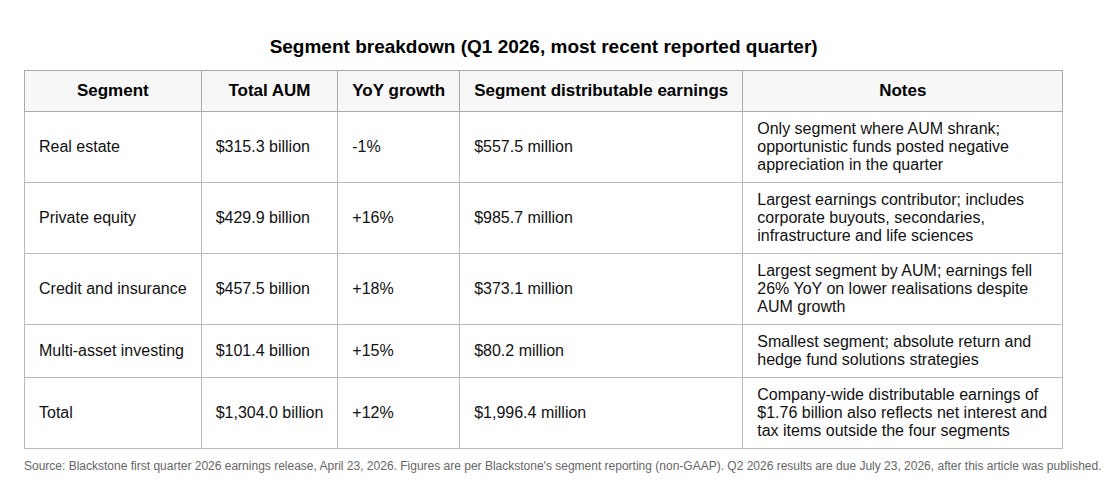
Private equity delivered the standout quarter: distributable earnings almost doubled year over year on the back of a strong secondaries close, a $10 billion-plus opportunistic credit fundraise sitting adjacent to it in Credit & Insurance, and appreciation across corporate buyouts and infrastructure funds. Multi-Asset Investing remains the smallest segment by a wide margin, built around Blackstone’s absolute return and hedge-fund-solutions business, but it grew fee-related earnings 28% year over year, the fastest pace of any segment, off a small base.
⚡ The core growth engine: becoming the AI economy’s financier of choice
The single idea that will make or break the bull case on Blackstone over the next few years is not a new fund strategy or a rebrand. It is whether the firm can keep deploying its own and its investors’ capital profitably into the physical infrastructure the AI industry needs, faster and at greater scale than any rival.
The scale of that bet is already large. Blackstone has committed to invest more than $25 billion in Pennsylvania’s digital and energy infrastructure, combining data centre development through its portfolio company QTS with a natural gas power generation joint venture alongside utility PPL, and says the initiative should help catalyse a further $60 billion of investment into the state. In Japan, president and COO Jon Gray has said Blackstone plans to invest roughly $30 billion in AI data centres over the next three to five years, building on its existing AirTrunk platform, which secured a record green loan of close to $1.24 billion for a Tokyo AI data centre in March 2026. In the UK, Blackstone has confirmed a $13 billion investment behind a hyperscale data centre on a derelict site in Blyth, Northumberland. In May 2026, Blackstone Tactical Opportunities put $1 billion into VoltaGrid, a distributed power company addressing the electricity scarcity that is now the binding constraint on new data centre construction.