



Buying a Bitcoin ETF meant making one decision: are you in or out? Not anymore. Today there are more than a dozen spot Bitcoin ETFs from a dozen different issuers, and the same $221 million “recovery” headline can mean completely different things depending on which fund it flowed into. That’s why we built Winvesta Crisps, to decode what’s actually moving the funds you own, in plain language, before the consensus catches up. 60,000+ investors from all over India are already in. What about you?
🔔 Don’t miss out! Get the latest updates delivered straight to your inbox →
Most investors saw the headline and exhaled. US spot Bitcoin ETFs pulled in $221.7 million on July 2, snapping a brutal 10-day, $2.73 billion outflow streak, the kind of number that makes a “bottom is in” thread go viral by lunchtime. But the data underneath that headline tells a different story. The fund that led every previous rally in this asset class barely showed up. If you own IBIT, FBTC, or any Bitcoin ETF, the question isn’t whether the outflows stopped. It’s who actually stopped them.
🎯 Meet Kabir

Kabir, 31, works in fintech operations in Bangalore. Portfolio: ₹38 lakhs, mostly QQQ and VOO for his “boring, long-term” allocation, built up over three years on Winvesta. In February 2026, with Bitcoin ripping toward $95,000 and every finance account on his feed calling it the next leg of the supercycle, he added a ₹4.2 lakh position in IBIT, BlackRock’s spot Bitcoin ETF, as his “5% moonshot.”
It has not felt like a moonshot lately. Bitcoin spent the back half of June falling to a 21-month low near $58,000, and June was the worst month on record for spot Bitcoin ETFs, with roughly $4.1 billion pulled from the category. Kabir’s ₹4.2 lakh position is worth closer to ₹2.8 lakhs now, a drawdown of roughly 33%, and he watched the “10-day outflow streak just ended” headlines last week with the kind of hope that comes from wanting to be told the pain is over.
Here’s what the headline didn’t tell him: the fund he actually owns, IBIT, was still bleeding on the exact day everyone was celebrating the reversal.
📊 What the ETF flows are actually saying

The category-level number looks like relief. The fund-level number looks like something else entirely.
On July 2, the SoSoValue-tracked complex of US spot Bitcoin ETFs took in $221.7 million, the largest single-day haul in two months. Fidelity’s FBTC led with roughly $166 million. ARK and 21Shares’ ARKB added about $92 million. VanEck’s HODL chipped in a small amount. Every fund in the category posted inflows or remained flat, according to The Block’s July 3 flow report, with one exception. BlackRock’s IBIT, the largest Bitcoin ETF by assets and historically the fund that absorbs 70 to 90 per cent of net inflows on a strong day, posted a $40.43 million outflow. It was IBIT’s eleventh straight day of net redemptions, part of a stretch that has drained roughly $2.2 billion from that single fund.
Note: The table below is directional and illustrative, drawn from SoSoValue and The Block’s published flow data as of July 2-3, 2026, not a live real-time feed. Verify current-day figures via Farside Investors, The Block, or CoinGlass before acting.
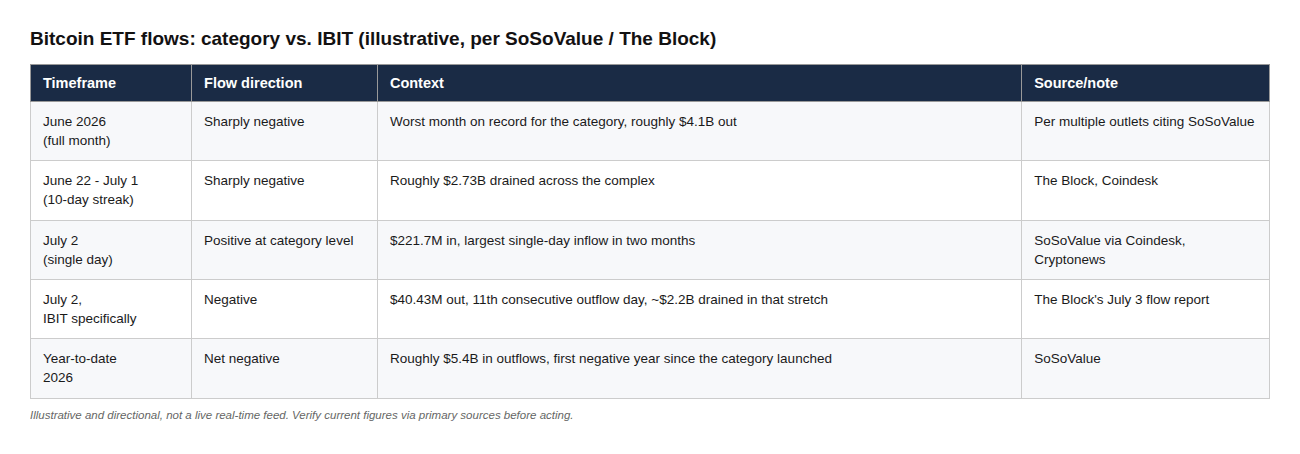
Read those five rows together and the story changes. This wasn’t institutional conviction returning to Bitcoin. It was second-tier issuers absorbing flow while the fund that usually leads kept losing money. Cryptonews called it plainly: a genuine institutional rotation back into Bitcoin should show up broadly across issuers, led by IBIT. What happened on July 2 looked more like tactical, possibly retail, reaccumulation in the smaller funds while the biggest holder of institutional conviction kept walking out the door.
🚀 Want to add Bitcoin ETF exposure to your portfolio, or trim what you already hold? Trade IBIT, FBTC, and other US-listed ETFs directly from India on the Winvesta app. No US bank account needed!
Join 60,000+ investors, become a paying subscriber or download the Winvesta app and fund your account to get insights like this for free!
🎲 Three scenarios for Kabir’s ₹2.8 lakh position

The following scenarios, probabilities, and return estimates are illustrative stress tests based on assumed outcomes and subjective probabilities. They are an editorial framework for thinking about risk, not a forecast, market consensus, or a guarantee of anything.
Scenario 1: The rotation becomes real (25% probability)
Setup: June’s CPI print on July 14 comes in soft, reinforcing the weak jobs data that already knocked down hike odds. Warsh’s Fed sounds dovish at the July 28-29 meeting. IBIT’s own outflow streak breaks, and inflows broaden across the issuer complex rather than concentrating in FBTC and ARKB alone. The CLARITY Act clears a procedural hurdle at its July 17 Senate hearing.
Illustrative 3-month outcome: Bitcoin recovers toward the $70,000-72,000 zone (+13-16% from current levels). Kabir’s IBIT position: ₹2.8L → roughly ₹3.22L (+15%).
Why only 25%: this needs the jobs-data soft patch, a dovish Fed, and a legislative unlock to all land in the same six weeks, and Citigroup just cut its own Bitcoin ETF flow expectations to roughly zero for the next year on the CLARITY Act sitting stuck in the Senate.
Scenario 2: Choppy consolidation into the Fed (50% probability)
Setup: The July 2 bounce partially holds but doesn’t extend cleanly. IBIT’s outflows slow but don’t reverse. Bitcoin trades in a wide $58,000-66,000 range through the July 14 CPI print and the July 28-29 FOMC meeting, with no clean resolution either way.