


Five years ago, owning a chip equipment company meant owning a cycle: you bought the downturn, sold the upturn, and watched China for the turn. Not anymore. Applied Materials just posted the fastest sequential revenue growth in its 59-year history, guided the December quarter to roughly $10.25 billion against $6.8 billion a year earlier, and the shares closed down 5.12% on 14 August 2026. The market is still pricing a cyclical. The order book is describing something closer to infrastructure. That's why we built Winvesta Crisps, to decode what's actually driving the companies you own, in plain language, before the consensus catches up. 60,000+ investors from all over India are already in. What about you?
🔔 Add winvestacrisps@substack.com to your email list so our updates never land in spam.
Most investors file Applied Materials under "semiconductor cycle": a supplier that sells machines to fabs, rides consumer electronics demand, and lives or dies on Chinese capital spending. The fiscal third quarter reported on 13 August 2026 argues against every part of that. Revenue reached a record $9.115 billion, up 25% on the year and up 15% sequentially, the largest quarter-on-quarter jump the company has ever recorded, per the earnings release. Non-GAAP gross margin hit 50.4%, the thirteenth consecutive quarter of year-on-year expansion. Management then guided the fourth quarter to about $10.25 billion, roughly 51% above the year-ago quarter. The stock fell $27.36 to $507.18. A company accelerating into its best guidance ever lost a twentieth of its value in a session. That gap is the story.
🧩 What Applied Materials actually sells
Applied does not make chips. It makes the machines that turn a blank silicon wafer into a chip, and it covers more of that sequence than anyone else: deposition, etch, ion implantation, chemical mechanical planarisation, thermal processing, inspection. ASML owns lithography, the step that prints the pattern. Applied owns most of the steps on either side of it, the ones that build and shape the physical structure.
That breadth matters more now than it did five years ago, and the reason is that chip progress stopped coming mainly from lithography.
The industry has moved from flat transistors to fin-shaped ones to gate-all-around structures, where the conducting channel is wrapped on all four sides. It has moved from single chips to stacks of chips bonded together, which is what advanced packaging means, and to high-bandwidth memory, which is DRAM dies stacked vertically and wired straight into an AI accelerator. Each of those shifts is a materials engineering problem rather than a printing problem. More layers, more interfaces, more precisely deposited films, more steps where atoms have to land in exactly the right place.
Every one of those steps is a machine Applied sells.
The revenue split shows how concentrated the business is.
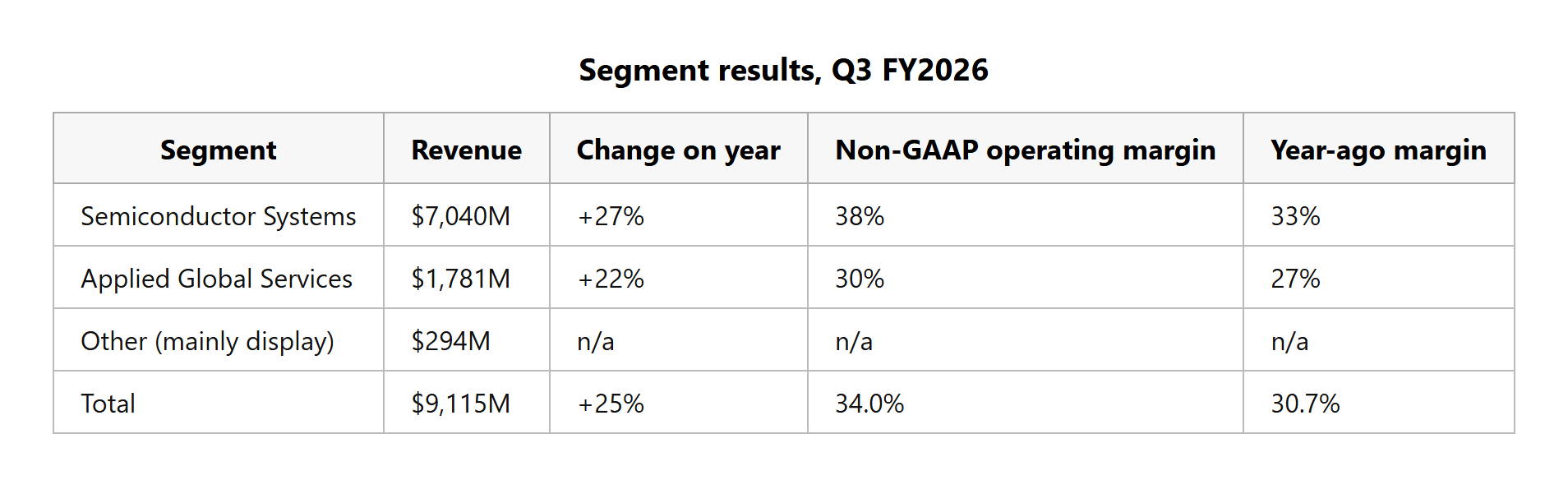
Semiconductor Systems, the equipment business, brought in $7.040 billion in the quarter, up 27% on the year and 18% sequentially, per the release. Its non-GAAP operating margin reached 38%, against 33% a year earlier and 35% in the prior quarter.
Applied Global Services, the part investors consistently undervalue, added $1.781 billion, up 22%, at a 30% non-GAAP operating margin against 27% a year ago. AGS sells spare parts, service contracts and upgrades on an installed base of tools already sitting in customer fabs. It is subscription-like revenue attached to hardware, and it keeps earning long after the machine is sold. When a fab runs its tools harder, which is what happens in an AI build-out, AGS revenue rises without Applied shipping anything new.
Everything else, mostly display equipment, came to $294 million. On a $9.1 billion quarter, display has stopped being a swing factor.
So the shape of the company is one dominant equipment franchise with a genuinely high-margin annuity bolted to it, and a residual business that no longer moves the number.