


Analyzing Apple meant counting iPhone units and worrying about China. Not this week. On Thursday, Tim Cook hosts his final earnings call as CEO before handing the company to John Ternus on September 1, and he does it with Apple sitting on a $5 trillion market cap it built partly by spending less on AI than almost anyone else in the Magnificent Seven. That combination, a leadership handover and a contrarian AI strategy getting validated in real time, is what this piece unpacks.
That’s why we built Winvesta Crisps, to break down what’s actually driving the companies you own, in plain language, before the consensus catches up. 60,000+ investors from all over India are already in. What about you?
🔔 Don’t miss out!
Add winvestacrisps@substack.com to your email list so our updates never land in spam.
Apple touched a $5 trillion market cap in intraday trading on 28 July 2026, becoming only the second listed company after Nvidia to get there. It got there while spending a reported $14 billion on capital expenditure for the year, against roughly $205 billion at Alphabet, according to consensus estimates cited by TipRanks. The stock is up close to 24% in 2026, the best performance of any Magnificent Seven name; at the same time, Microsoft has shed nearly a fifth of its value, fretting over the returns on its own AI spending. Most retail investors still frame Apple as the company playing catch-up on artificial intelligence, licensing Google’s Gemini because it couldn’t build a frontier model of its own in time. The market has started framing it differently: as the one large technology company that worked out how to profit from the AI cycle without funding the infrastructure war underneath it. Both readings are true at once, and reconciling them is the whole story this quarter.
The timing compounds the intrigue. Cook’s Thursday call, covering fiscal third-quarter 2026 results for the quarter ended in late June, is his last as chief executive after 15 years in the job. John Ternus, Apple’s hardware engineering chief for the past several years, takes the title on September 1, becomes a board member, and inherits a company at its most valuable moment in history. He has already made his first significant call from the CEO’s chair, and it involved killing one of Cook’s own strategic bets. What Apple actually does next matters more than what any single earnings print says about it.
📱 What Apple actually does today
The Wikipedia version says Apple sells iPhones. The accurate version is that Apple runs a five-line business built to keep a 2.5 billion-plus device installed base paying it every year, with the iPhone as the entry point rather than the whole story.
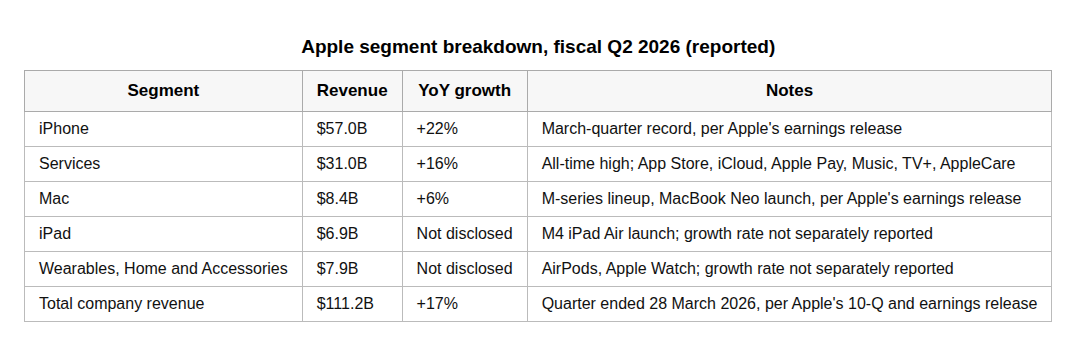
iPhone remains the anchor, at 51% of revenue in the most recently reported quarter, per Apple’s own segment disclosure. But the growth underneath it has shifted character. Fiscal Q2 2026 iPhone revenue hit $57.0 billion, up 22% year over year and a March-quarter record, driven by the iPhone 17 family and genuine supply constraints on system-on-chip components, not just marketing push, according to Apple’s earnings release and Tim Cook’s remarks on the call. Services, at 28% of the mix, is the business that actually explains Apple’s valuation: the App Store, Apple Music, Apple TV+, iCloud, Apple Pay, AppleCare and advertising together posted an all-time high of $31.0 billion in the same quarter, up roughly 16%, at gross margins in the mid-70s versus the high-30s to low-40s that hardware carries.
Mac, iPad, and Wearables round out the picture at single-digit-billion quarterly scale each, useful less for their own growth than for widening the surface area of devices that Services can be sold into. India has become a structural piece of this too, not just a growth market for iPhones but a manufacturing base: Tata Electronics and Foxconn now run five assembly plants between them, and India’s share of global iPhone assembly is projected to reach roughly a quarter to 28% of the total in 2026, according to Counterpoint Research estimates, up from about 18 to 20% two years earlier. That shift is doing double duty, hedging Apple’s China concentration while giving it a tariff-advantaged export base for the US market.
🎯 The bet that decides the next five years
Apple’s defining strategic call this cycle isn’t a product. It’s a decision about how much to spend proving AI works before charging for it.