


Five years ago, the Apple debate was simple: count the iPhones, check China, move on. Not anymore. This year Amazon alone expects to spend roughly $220 billion on capital projects, most of it on AI data centres, while Apple is expected to spend just over $11 billion, and Apple is the one trading at a record. The market is paying Apple for what it chose not to do, and tonight's results are the first real test of whether that premium holds up against a memory bill that keeps climbing. That's why we built Winvesta Crisps, to decode what's actually driving the companies you own, in plain language, before the consensus catches up. 60,000+ investors from all over India are already in. What about you?
🔔 Don't miss out!
Add winvestacrisps@substack.com to your email list so our updates never land in spam.
Most investors still think of Apple as the company that missed the AI boom, the one whose assistant was late, whose chatbot never arrived and whose new Siri had to borrow its brain from Google. The share price says the opposite. Apple closed at a record $348.91 on 29 October, per StockAnalysis data, and by Friday's close it was again worth more than Nvidia, at roughly $5.03 trillion against Nvidia's $4.93 trillion, per Yahoo Finance. That happened in the same week that Alphabet fell roughly 12% to 13% after its own results and Amazon slid after telling investors it still plans about $220 billion of capital spending this year. Apple reports its fiscal fourth quarter after the US market closes today, with analysts expecting revenue of roughly $113.5 billion, and for the first time in fifteen years the person explaining the numbers will not be Tim Cook. The gap between Apple's reputation as an AI laggard and its position as the market's favourite AI hedge is the story worth understanding before tonight.
🧩 Business model: a hardware company with a software margin attached
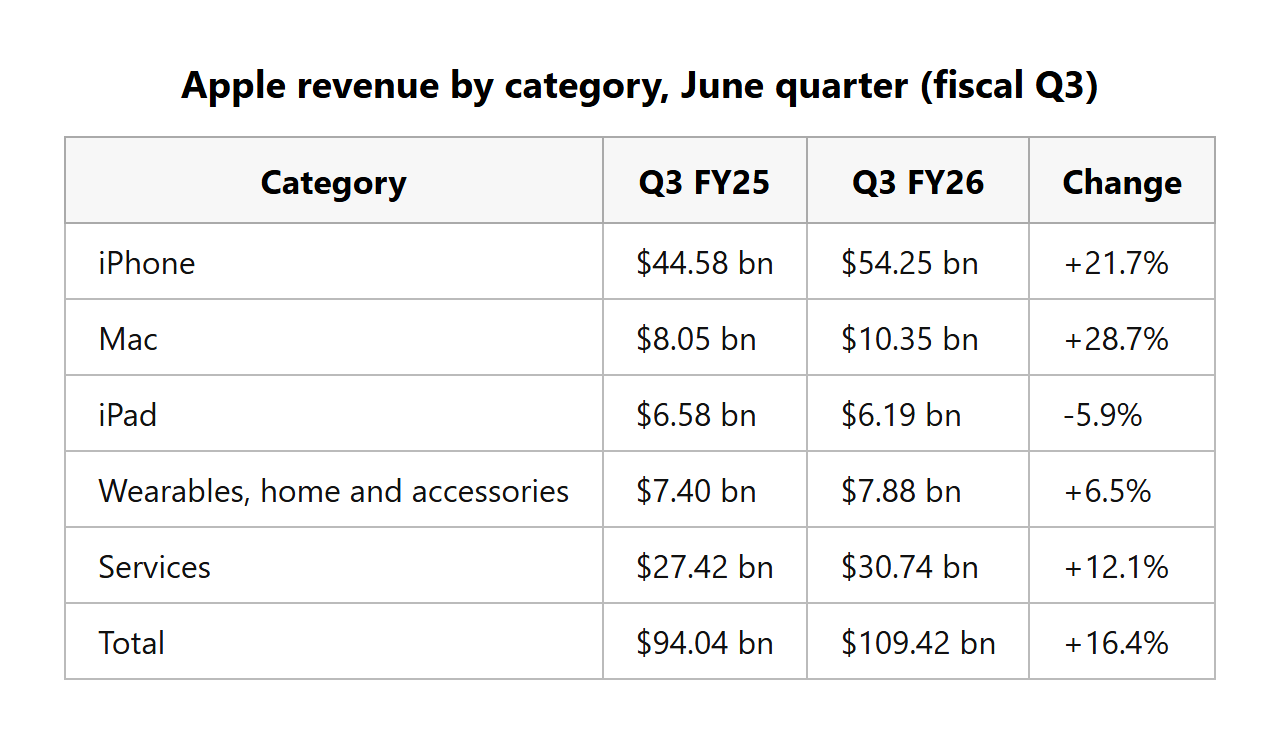
Apple makes most of its money selling devices and a growing share of its profit renting access to the people who own them. In the June quarter, the third of Apple's fiscal 2026, total revenue rose roughly 16% year on year to $109.4 billion, per the company's own release. Products brought in $78.7 billion of that and Services $30.7 billion. On those numbers alone, Apple looks like an iPhone company with some extras, and the iPhone did carry the quarter: revenue of $54.3 billion, up nearly 22%, which Cook called a record for a June quarter.
The profit picture is very different from the revenue picture. Products earned a gross margin of roughly 40% in the June quarter, per Apple's own figures. Services earned roughly 75.6%. That means a dollar of App Store commissions, iCloud storage, Apple Music, AppleCare or the payments Google makes to remain Safari's default search engine is worth almost twice as much gross profit as a dollar of iPhone sales. Services made up less than 30% of revenue in the June quarter but roughly 42% of gross profit, per Apple's numbers. Apple has said it has well over a billion paid subscriptions across its platform.
This is why the installed base matters more than any single launch. Every iPhone sold is the entry ticket to a decade of high margin services revenue, and Apple has built that base without taking the risk the other giants are taking now. It does not sell computing power to anyone. It does not need to fill a data centre to justify the one it already built. When the AI trade wobbles, Apple has less to lose, and over the past month that has looked less like a weakness and more like the whole point.