


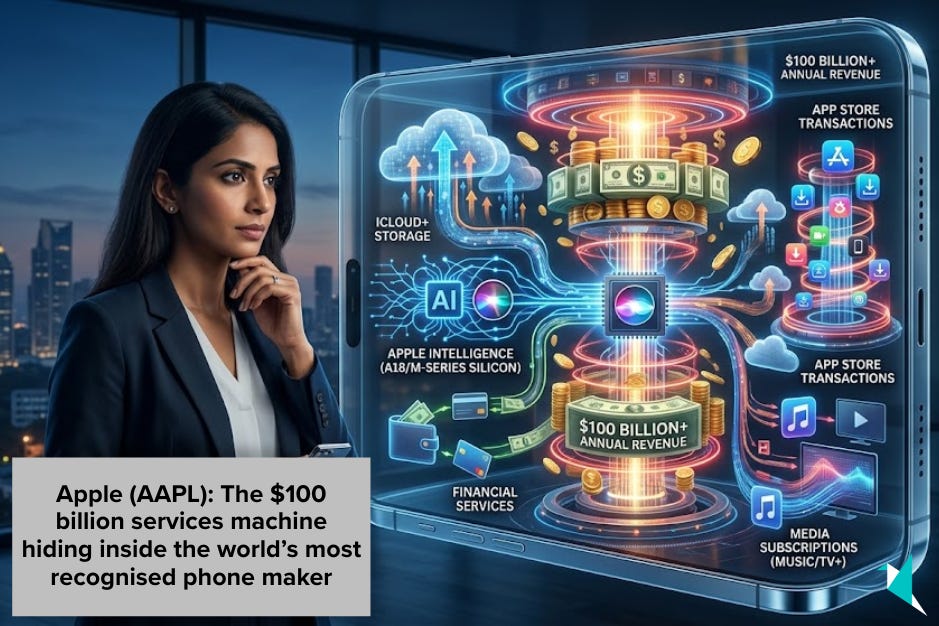
Tracking Apple meant counting iPhone units and worrying about China. Not anymore. The company has quietly assembled a services empire generating margins that would make most SaaS CEOs envious. It is now layering Apple Intelligence across more than 2.5 billion active devices, up from 2.35 billion a year earlier, turning every iPhone into a recurring-revenue platform. The investing thesis has fundamentally shifted, and most retail investors haven’t caught up.
That’s why we built Winvesta Crisps, to break down what’s actually driving the companies you own, in plain language, before the consensus catches up. 60,000+ investors from all over India are already in. What about you?
🔔 Don’t miss out!
Add winvestacrisps@substack.com to your email list so our updates never land in spam.
Most investors still think of Apple as a hardware company that sells expensive phones. That framing is accurate and dangerously incomplete. Today’s Apple simultaneously operates the world’s most profitable consumer electronics business, a services platform that crossed $109 billion in annual revenue in FY2025 with gross margins above 70%, and a closed-loop AI ecosystem powered by proprietary silicon that no Android manufacturer can replicate at the device level. It processes over a billion transactions through the App Store, manages cloud storage for hundreds of millions of users, and is now deploying Apple Intelligence, on-device AI built directly into its A18 and M-series chips, across an installed base that spans every continent.
The transformation isn’t cosmetic. Tim Cook has methodically shifted Apple’s revenue mix from hardware-dependent to services-augmented, building what is arguably the most defensible consumer technology franchise in the world: a closed ecosystem where switching costs are high, personal data stays on-device, and every new product or software feature locks users in more deeply. The question for investors today isn’t whether Apple makes excellent products; it demonstrably does, but whether the market correctly prices a business that is simultaneously the world’s most profitable hardware maker and a fast-growing, high-margin software platform with AI optionality baked into every chip it designs.
🧩 Business model 2.0: From device sales to the world’s stickiest platform
Apple’s revenues now flow from five distinct engines, not just iPhone units shipped, a shift that reflects Cook’s decade-long push to reduce hardware cyclicality and build recurring revenue streams. Segment dollar figures for iPhone, Mac, iPad, and Wearables below are rounded approximations based on Apple’s segment reporting and widely cited analyst breakdowns, rather than exact Apple-printed line items.
iPhone
The original franchise still dominates, contributing roughly half of Apple’s approximately $391 billion in FY2024 revenue, per Apple’s official earnings release. iPhone 16 and 16 Pro launched in September 2024 with Apple Intelligence capabilities tied to the A18 chip, targeting hundreds of millions of older-model iPhones due for replacement. Average selling prices have held in the mid-$800s globally, per analyst estimates, as higher-end Pro models continue taking share within Apple’s own lineup. The introduction of AI features tied specifically to newer hardware creates an upgrade incentive disconnected from traditional camera or performance cycles; users now upgrade for on-device intelligence, not megapixels.
Services
This is the transformation story. Apple’s Services segment, comprising the App Store, Apple Music, Apple TV+, Apple Arcade, iCloud+, Apple Pay, Apple Card, and Apple Advertising, generated approximately $96 billion in FY2024 revenue, up roughly 13% year-over-year, per Apple’s earnings release. Gross margins on Services run above 70%, compared with roughly 35% for hardware, making each incremental dollar of Services revenue nearly twice as valuable to Apple’s bottom line. The segment has become the largest driver of Apple’s overall margin expansion. Services exceeded $109 billion in FY2025, up roughly 14% from FY2024, firmly past the $100 billion milestone that once seemed ambitious, per publicly available FY2025 data.
Mac and iPad
Mac revenue came in at approximately $30 billion in FY2024, driven by the M-series chip transition that has given Apple’s computers meaningful performance and energy-efficiency advantages over Intel-based Windows machines for specific workloads. iPad contributed approximately $26 billion. Both segments benefit from the broader Apple ecosystem flywheel; users who own an iPhone are meaningfully more likely to own a Mac and iPad, creating multi-device monetisation that no Android manufacturer can replicate at scale.
Wearables, Home, and Accessories
AirPods, Apple Watch, and HomeMini generated approximately $37 billion in FY2024, per Apple’s category reporting and analyst estimates, a business that rivals most Fortune 500 companies in scale, yet sits well below the headlines. Apple Watch holds the largest share of the global smartwatch market by revenue. AirPods dominate premium wireless audio. Both product lines are sticky: once inside the Apple ecosystem, users rarely switch to competitors because the iPhone integration is seamless, a quality that third-party alternatives cannot match.
Vision Pro and spatial computing
Apple’s Vision Pro launched in February 2024 at $3,499. Unit volumes remain small relative to iPhone, industry estimates place sales in the hundreds of thousands through 2024, not millions, and Apple does not disclose standalone Vision Pro figures. Vision Pro represents Apple’s long-horizon positioning for spatial computing, a category that may define the post-mobile era. The current product is best characterised as a developer and early-adopter platform; the mass-market version, if it arrives at a significantly lower price point, is the medium-term bet.
In other words, “Apple” is now a recurring-revenue platform with a high-margin software engine, AI infrastructure embedded in its chips, and hardware that functions primarily as a distribution mechanism, not the iPhone company clinging to upgrade cycles.
🌪️ Apple Intelligence and the AI upgrade cycle: A demand driver unlike any before it
The generative AI wave has reshaped device upgrade economics in a way that structurally benefits Apple more than any other consumer hardware maker, and the dynamics are still in their early stages.
On-device AI as the hardware upgrade incentive
Apple Intelligence requires the A17 Pro or A18 chip, found in the iPhone 15 Pro and the iPhone 16 family, to run its full feature set on-device. Industry estimates suggest several hundred million iPhones globally are running on hardware older than the minimum requirement. As Apple Intelligence matures with each iOS release, deeper personalisation, more capable Siri, and third-party app integrations, the gap between eligible and ineligible devices widens. Unlike previous upgrade drivers, this one is software-compounding: the features don’t freeze at launch; they accumulate, making the upgrade logic more compelling with every update rather than fading as competitors match the spec sheet.
Mac and iPad as AI workstations
Apple’s M4 chip, announced in 2024, features a Neural Engine delivering over 38 TOPS of on-device AI performance. For creative professionals, developers, and small businesses handling sensitive data, the ability to run AI models entirely on-device, without data leaving the machine, is increasingly a selling point over cloud-dependent alternatives. Microsoft’s Copilot+ PC initiative validates the category; Apple’s advantage is that it controls the hardware, operating system, and silicon design simultaneously, enabling the kind of co-optimisation that Qualcomm-based Windows machines can only approximate.
India and emerging markets are the structural growth frontier.
Apple’s revenue in India has grown substantially over recent years as the company has invested in local manufacturing and retail expansion. With iPhone production ramping at Tata-operated facilities, Apple is broadening its addressable market while hedging against geopolitical supply-chain concentration in China. India represents one of the largest pools of aspirational smartphone upgraders globally. As incomes rise and Apple’s brand positioning strengthens in the market, the company’s India trajectory could, over a longer arc, replicate what China delivered over the decade before current tensions.
For a firm that monetises both hardware and the services that attach to it, an AI-driven upgrade cycle typically means accelerated revenue and sticky services engagement from an expanding new-device base.
🕵️♀️ Services: The $100 billion software company hiding inside a hardware brand
One of the most strategically important businesses in global technology sits inside Apple’s earnings report, persistently underweighted by investors who still anchor to iPhone unit volumes.
App Store economics
The App Store generated an estimated $85 billion in gross developer billings in 2023, according to Sensor Tower's industry estimates, with Apple retaining 15–30% of transactions under its reported commission structure. Developer activity on iOS generates a flywheel: more developers build for iOS because consumer spending is highest there; higher-quality apps increase iPhone stickiness; stickier iPhones attract more developers. Epic Games’ legal challenge and the EU Digital Markets Act's requirements have mandated some adjustments to App Store rules in certain markets. Still, court outcomes have broadly preserved Apple’s core commission economics globally, though this remains an active regulatory risk.
Apple TV+ and the bundle moat
Apple TV+, priced at $9.99 per month in the US, has accumulated a growing library of prestige original content. Apple does not disclose subscriber counts, but industry estimates place the figure at 25–40 million globally. The strategic purpose of TV+ differs from Netflix’s: Apple doesn’t need it to be a standalone profit centre. It justifies a higher iCloud bundle price, reduces ecosystem churn, and generates an awards-season brand signal that reinforces Apple’s premium positioning. A smaller, curated library with a disproportionate critical profile, Ted Lasso, Severance, and The Morning Show, is the deliberate design.
iCloud and the storage escalator
iCloud generates predictable recurring subscription revenue from hundreds of millions of users storing photos, contacts, and device backups. Storage tiers range from 50GB at $0.99 per month to 2TB at $9.99, with higher-capacity options available above 2TB in many markets. As camera quality improves and video file sizes grow, users migrate toward higher tiers over time, creating a built-in revenue escalator. The business is high-margin, highly predictable, and has essentially zero customer acquisition cost, since every new iPhone sale automatically expands the addressable market for iCloud.
Apple Pay and financial services
Apple Pay processes trillions of dollars in transaction volume annually, per industry estimates, making it one of the world’s largest mobile payment platforms by usage in markets like the US, UK, and Australia. Tap to Pay, which allows iPhones to accept card payments directly, without additional hardware, positions Apple as a potential disruptor of the small-business payments infrastructure layer. Apple’s financial services moves are consistent and incremental; no single product dominates, but the cumulative positioning across payments, lending, and savings builds lock-in at a layer most investors don’t price in.
Consider Arjun, an investor in Bengaluru holding AAPL for two years: each year his cost basis looks more attractive, not because the phone got better, but because the services attached to the phone, Apple Music, iCloud, TV+, keep compounding in value and margin, independent of whether he upgraded his handset.
This segment combines high gross margins, structural growth, and deep ecosystem lock-in, very different economics from the hardware business that still defines Apple’s external identity.
Want to add Apple to your portfolio? Trade AAPL directly from India on the Winvesta app. No US bank account needed!
🚀 Join 60,000+ investors, become a paying subscriber or download the Winvesta app and fund your account to get insights like this for free!