


Five years ago, analysing AMD meant comparing clock speeds against Intel chips in a personal computer market that barely grew year on year. Not anymore. In 2026, AMD handed one customer a path to ten per cent ownership of the company in exchange for a multi-year chip order, and the market is still working out what that means for every other AI infrastructure stock. That's why we built Winvesta Crisps - to decode what's actually driving the companies you own, in plain language, before the consensus catches up. 60,000+ investors from all over India are already in. What about you?
🔔 Don't miss out!
Add winvestacrisps@substack.com to your email list so our updates never land in spam.
Most investors who follow AMD still see a solid, slightly cheaper alternative to Nvidia, a stock that does well when Nvidia cannot build chips fast enough and struggles once supply catches up. That framing is accurate and dangerously incomplete. Through 2026, AMD turned its largest prospective customers into financial partners, wiring their chip orders directly into the AI industry's capital structure. The clearest evidence sits inside a single legal document: a warrant that could eventually hand OpenAI a tenth of AMD, issued not for cash but for a promise to buy AMD's chips at scale.
🏭 What AMD actually is today
AMD builds and sells four distinct product lines, not one. Data Center is EPYC server processors and Instinct AI accelerators sold to cloud providers and AI labs, and it is now the company's main growth engine. Client is Ryzen processors for laptops and desktops, the business most people still associate with the AMD name. Gaming covers semi-custom chips for PlayStation and Xbox consoles alongside Radeon graphics cards, and it is the most cyclical and currently the weakest of the four. Embedded, built around the 2022 acquisition of Xilinx, sells specialised chips into industrial, automotive and aerospace customers who value long product lifecycles over raw speed.
What has changed is the mix. Data Center has gone from a meaningful contributor to the majority of revenue inside two years, and that shift is why AMD now trades, rightly or wrongly, as an AI infrastructure stock first and a PC chipmaker second.
🧩 Segment breakdown
Second-quarter 2026 revenue was concentrated in Data Center to a degree AMD has never shown before, with EPYC and Instinct sales more than doubling year on year while the older consumer-facing businesses grew more slowly or shrank.
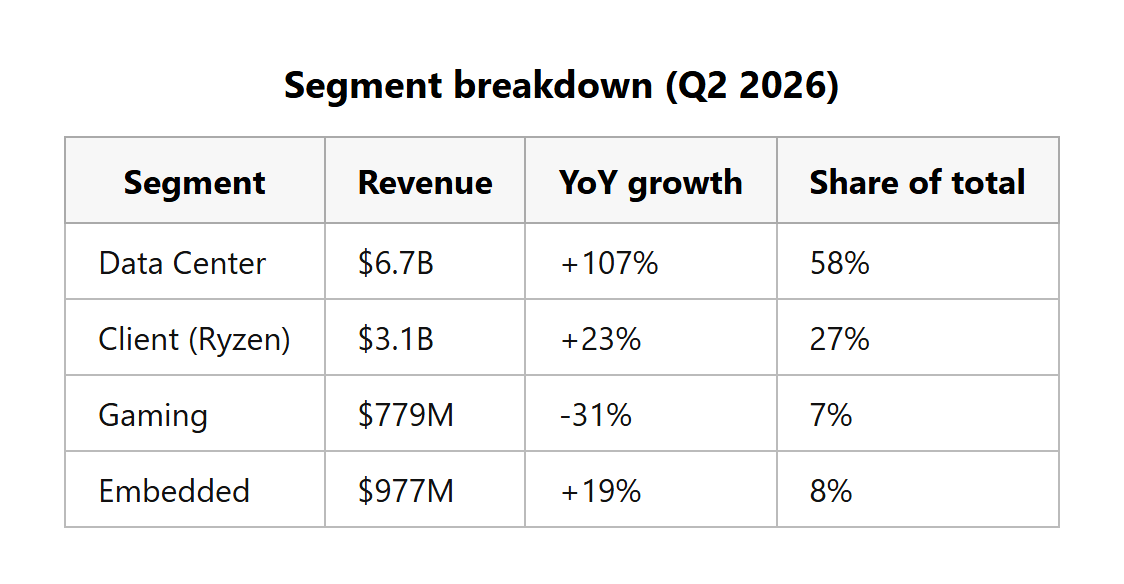
Gaming's decline is mostly semi-custom console chip revenue normalising after a strong prior period, per AMD's Q2 2026 earnings release, rather than a sign of weakness in Radeon graphics cards specifically. Embedded's steady growth reflects industrial and automotive demand that moves on multi-year design cycles, largely insulated from the AI capital expenditure cycle driving the Data Center numbers.
⚡ The core strategic bet: six gigawatts and a warrant
In October 2025, AMD and OpenAI announced a partnership for OpenAI to deploy up to six gigawatts of AMD Instinct GPUs over multiple years, starting with one gigawatt of the next-generation MI450 series in the second half of 2026, per AMD's official announcement and SEC filing. Alongside the compute order, AMD issued OpenAI a warrant for up to 160 million AMD shares, roughly ten per cent of the company, at an exercise price of one cent each.