


Eighteen months ago the AI buildout was funded almost entirely out of retained earnings. This year roughly a third of it is being funded with borrowed money, and those bonds land in the same market that sets the discount rate on AI shares. Investors who own the trade now own both ends of it. That's why we built Winvesta Crisps: to break down what's actually moving markets, in plain language, before the consensus catches up. 60,000+ investors from all over India are already in. What about you?
🔔 Don't miss out!
Add winvestacrisps@substack.com to your email list so our updates never land in spam.
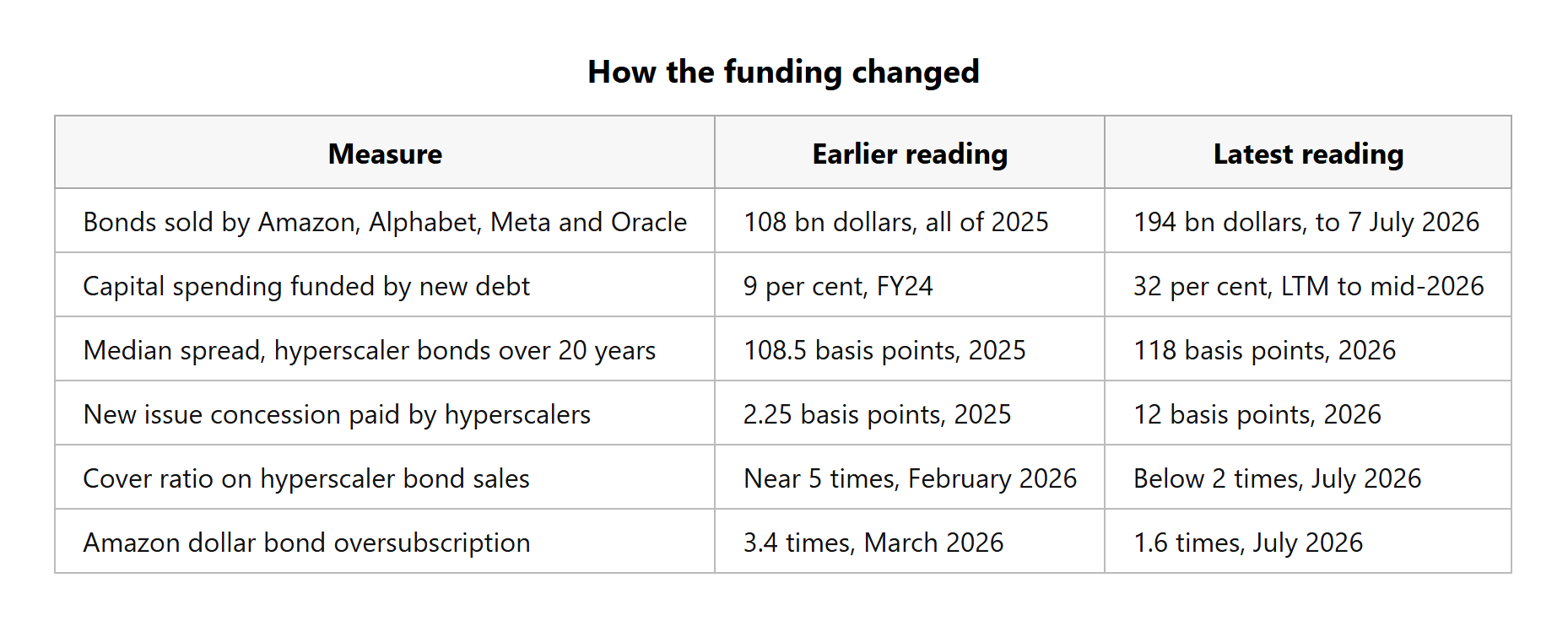
The AI trade has always been described as an equity story. Companies with enormous cash piles spend some of it on chips and buildings, the spending shows up as revenue at Nvidia, and the share prices go up. That description was accurate until about eighteen months ago. It is not accurate now. Amazon, Alphabet, Meta and Oracle have sold roughly 194 billion dollars of bonds so far this year, up about 79 per cent from around 108 billion dollars in all of 2025, per a Reuters analysis published on 29 July. The buildout has become one of the largest borrowers in the world, and the money it borrows comes from the same pool of long-term lenders who fund the US government. That is the part almost nobody has priced properly, because it runs the wrong way round: the debt that pays for the data centres helps set the interest rate that values the data centres.
🏗️ How the buildout stopped funding itself
For the first two years of the AI capital cycle the spending was genuinely self-financed. The Dallas Fed estimates that roughly 500 to 600 billion dollars of AI data centre investment since 2023 came out of retained earnings. Cash flow was so far ahead of capital spending that the debt question never came up.
The gap has closed. Incremental annual debt has risen from 9 per cent of capital spending in FY24 to 32 per cent in the twelve months to mid-2026, per FactSet, and aggregate debt across the five largest spenders now sits near 700 billion dollars. Moody's, which put out a note in July warning that the pace threatens credit quality at the six companies it tracks, expects capital spending of about 785 billion dollars this year and close to a trillion next year. Meta's trailing twelve month free cash flow swung to a 7.6 billion dollar outflow in the second quarter, its first negative reading since 2023. Amazon sold about 54 billion dollars of bonds in March. Nvidia, of all companies, sold 25 billion dollars in June. Alphabet went to the equity market instead and raised 84.75 billion dollars, the largest listed corporate equity transaction on record.
Bonds are only the visible part. Private credit funds have gone from near zero to over 200 billion dollars of outstanding loans to AI related companies, mostly originated by a handful of managers. Moody's counts 1.2 trillion dollars of lease commitments across the group, of which more than 820 billion dollars relates to facilities that have not started operating yet. QTS Realty raised 3.9 billion dollars of investment grade paper for a single Georgia data centre at a yield of about 7.23 per cent, which is an investment grade rating at a high yield price.
Add it up and AI financing is now close to a quarter of all gross investment grade bond issuance in the United States. August set a monthly record at 145.2 billion dollars of high grade supply, beating the 136 billion dollars sold in the same month of 2020. Issuance from January to mid-August reached 1.68 trillion dollars, about 27 per cent ahead of the same period last year.
⚙️ How a data centre bond reaches your share price
The chain has four links and each is arithmetic rather than sentiment.
The first link is duration supply. A twenty or thirty year corporate bond is not just a claim on a company. It is a block of interest rate risk that somebody has to hold, and the pool of investors willing to hold thirty years of it is finite. Pension funds, insurers and long bond funds have a fixed appetite. When new long-dated paper arrives in size, those buyers do not absorb it at yesterday's price. They ask for more yield. The Dallas Fed paper by Hugo De Vere, Srini Ramaswamy and Seth Searls, published in February, names this directly: AI issuance is now a material source of duration supply, and it partly substitutes for other investment grade borrowers.
The second link is who else is queueing. Total US federal debt passed 40.05 trillion dollars on Tuesday, and the deficit is running above last year's. The Treasury has to sell duration into the same buyers, at the same time, in an environment where inflation has been above the Fed's 2 per cent target for more than five years. Neither borrower is bidding against the other in a formal auction, but they are asking the same investors the same question, and the answer has been getting more expensive. The 30-year Treasury yield touched 5.33 per cent on 18 August, its highest level since 2007, against a Fed funds target range of 3.50 to 3.75 per cent. That gap of more than a percentage point and a half is not a forecast of rate rises. It is the term premium: what lenders charge for the uncertainty of committing money for three decades.
The third link is the one most equity investors have never had spelled out. A share price is the value today of profits a company will earn in the future, and the long government bond yield is the base rate used to discount them. Raise that rate and every future dollar of profit is worth less today. The effect scales with how far out the profits sit. A dollar expected in ten years loses roughly 9 per cent of its present value when the discount rate goes from 4.3 to 5.3 per cent. Push the same dollar out to thirty years and it loses about 25 per cent. Nothing about the company has to change.
The fourth link closes the loop. The companies whose value sits furthest in the future are exactly the ones issuing the debt. An AI data centre is a bet that revenue arrives in the 2030s, funded by bonds that mature in the 2050s, sold to investors who set the discount rate applied to that same 2030s revenue. Technology alone was 37.2 per cent of the S&P 500 as at 14 August, per S&P Dow Jones Indices, so this is not a corner of the index. It is most of it.
One honest caveat, because it matters. The long end is being pushed around by several forces at once, and AI issuance is a contributor rather than the whole story. The deficit is doing work. So is an oil supply shock that has kept headline inflation elevated. And credit spreads for companies with nothing to do with AI have barely moved, remaining close to historic lows, which tells you the crowding out is showing up in the government curve and in AI borrowers' own pricing rather than across the whole corporate market. The chain is real. It is one of three or four hands on the same lever.
The dynamics covered in this article affect every US stock in your portfolio. Trade from India on the Winvesta app. No US bank account needed!
🚀 Join 60,000+ investors, become a paying subscriber or download the Winvesta app and fund your account to get insights like this for free!
🏆 Winners and losers when AI borrows
The market has already started discriminating, and it is doing it inside AI credit rather than across the market. Directions below are illustrative and directional, not forecasts.
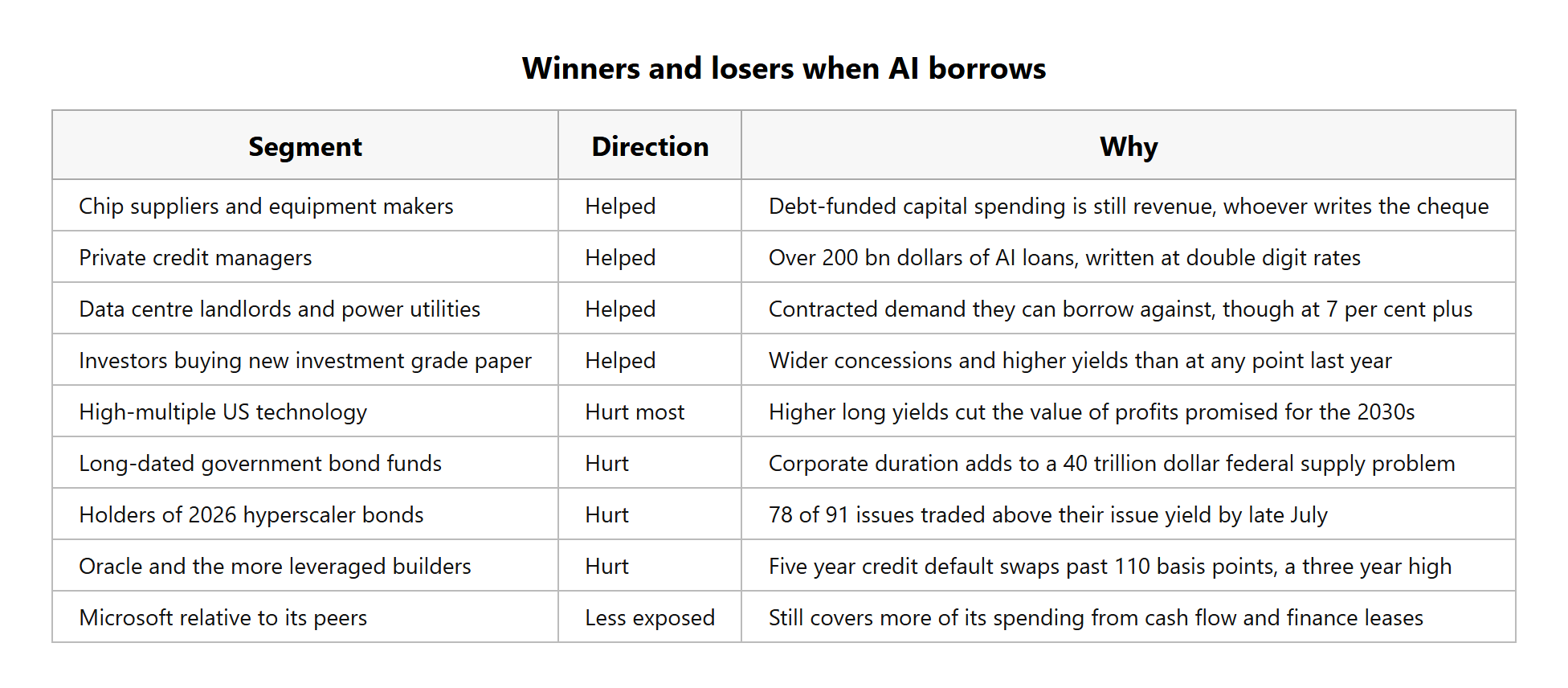
The clearest evidence that lenders are pushing back is in the terms, not the headlines. Cover ratios on hyperscaler bond sales, which measure investor orders against the amount on offer, fell from nearly five times in February to below two times in July, per Apollo Global Management. Amazon's March dollar deal was 3.4 times oversubscribed and its July deal only 1.6 times. The new issue concession, the extra yield a borrower pays to get a deal away, went from 2.25 basis points last year to 12 basis points this year. Of 91 hyperscaler bonds issued in 2026 with comparable pricing, 78 were trading at higher yields on 28 July than at issue, a median 22 basis points worse. Oracle's five year credit default swaps have pushed past 110 basis points, the widest in three years.
Note the two rows that cut against instinct. Nvidia and the chip supply chain still benefit from all of this, because debt-funded capital spending is revenue whoever writes the cheque, and that is precisely why the revenue quality question keeps being asked. And long-dated government bond funds, the thing many investors hold as protection against an equity fall, are being hurt by the same force at the same time.
🇮🇳 What this means for Indian investors holding US equities
Indian money has been moving into US equities at pace. Remittances under the Liberalised Remittance Scheme for the purchase of equity and debt reached 456.7 million dollars in June alone, more than double a year earlier, against total LRS outflows of 28.98 billion dollars in FY 2025-26, per RBI data. Almost all of that equity money goes into the same place: large-cap US technology, either directly or through an index that is 37 per cent technology by weight.
That leaves an Indian portfolio holding one half of a two-sided trade. The AI buildout is now financed with a stack of debt and equity, and the debt sits senior. Bondholders and private credit lenders get paid before shareholders, they have covenants, and they have been repricing their risk in public since February through cover ratios and concessions. Equity holders have the residual claim and no such mechanism. If the depreciation schedules on this hardware turn out to be shorter than assumed, or the lease commitments that have not started yet begin on worse terms, the loss lands on the junior claim first. The credit market is telling you what it thinks of the risk. Indian retail investors are almost entirely on the other side of that conversation, and the pricing signal sits in an asset class they cannot easily buy.
The currency layer compounds rather than cancels. The rupee has traded in the mid 95s to the dollar this week and is roughly 10 per cent weaker over twelve months. A weaker rupee flatters the rupee value of existing US holdings, which is the good news. It also raises the cost of every subsequent dollar remitted under LRS to add to those holdings, and higher US long yields tend to support the dollar, so the two forces in this article push the same way on the exchange rate.
The practical response is not to trade the bond market. It is to know that a portfolio built on high-multiple US technology is a leveraged position in long-term US interest rates whether it was constructed that way or not, and this is the year that becomes visible. If the entire US allocation is in the AI complex, that is a concentration decision rather than a diversification one. A systematic monthly investment into broad index exposure keeps buying through a repricing instead of trying to guess where it ends.
🔭 What to watch from here
The 30-year Treasury yield is the transmission channel, not the Fed funds rate. Watch the gap between the two. A term premium that keeps widening while the policy rate sits still is the signal that supply, not the Fed, is setting the price of long money.
Treasury buyback operations start their expanded run on 9 September. Scott Bessent's department is raising the maximum size of liquidity support buybacks for longer-dated nominal coupons from 2 billion to at least 4 billion dollars per operation in the 10 to 20 year and 20 to 30 year buckets, running through 4 November. The first attempt at this on 19 August pulled the 30-year down about 9 basis points to 5.196 per cent, and the move was gone within two sessions, with the yield back at 5.234 per cent on Thursday 20 August and 5.273 per cent on Friday 21 August. Whether the larger operations hold better is the cleanest live test of whether debt management can offset supply.
Cover ratios and new issue concessions on the next round of hyperscaler deals will tell you more than any analyst note. Lenders commit money rather than opinions. A concession drifting back towards last year's 2 basis points means appetite has returned. Wider means the buildout is getting more expensive to fund at exactly the moment it is getting bigger.
Capital spending guidance is the other side of the same question. Goldman Sachs expects the five hyperscalers to issue roughly 250 billion dollars of bonds this year and 400 billion dollars next year. If third quarter results raise capex again without raising the cash flow that covers it, the borrowing forecast goes up with it.
Two policy dates frame the autumn. Kevin Warsh gives his first Jackson Hole keynote as Fed Chair on Friday, three weeks before the 15 to 16 September FOMC meeting, and the July decision was a 9-3 hold with three regional presidents dissenting over inflation. How the statement treats supply-driven inflation matters more for the long end than the decision itself.
If this changed how you read an AI headline, pass it on.
🏁 The bottom line
The AI buildout has quietly changed from a cash story into a credit story, and that changes what owning it means. When capital spending came out of retained earnings, the only question was whether the projects would earn a return. Now that a third of it comes from borrowed money, a second question sits on top: what does the market charge to lend for thirty years, and what does that rate do to the value of profits promised for the 2030s. The same investors answer both questions, and their answer has been getting more expensive since February. Indian investors buying US technology are buying the junior claim on that trade while the senior claim reprices in public. Watching the 30-year yield is not a bond market hobby. For a portfolio concentrated in long-duration technology, it is the most direct read available on what those shares are worth.
📊 By the numbers
194 billion dollars: bonds sold by Amazon, Alphabet, Meta and Oracle through 7 July 2026, up about 79 per cent from roughly 108 billion dollars in all of 2025, per Reuters
9 per cent to 32 per cent: incremental annual debt as a share of hyperscaler capital spending, FY24 against the twelve months to mid-2026, per FactSet
785 billion dollars: Moody's estimate of 2026 capital spending across the six companies it tracks, heading towards about a trillion dollars in 2027
About a quarter: AI financing's share of gross US investment grade bond issuance, against record August supply of 145.2 billion dollars
Near 5 times to below 2 times: cover ratios on hyperscaler bond sales, February against July 2026, per Apollo Global Management
2.25 to 12 basis points: the new issue concession paid by hyperscaler borrowers, 2025 against 2026
5.33 per cent: the US 30-year Treasury yield on 18 August, its highest since 2007, against a Fed funds target range of 3.50 to 3.75 per cent
40.05 trillion dollars: total US federal debt as at Tuesday 25 August
1.2 trillion dollars: hyperscaler lease commitments counted by Moody's, of which more than 820 billion dollars has not started yet
456.7 million dollars: Indian LRS remittances for equity and debt purchases in June 2026, more than double a year earlier, per RBI
Disclaimer: All content provided by Winvesta India Technologies Ltd. is for informational and educational purposes only and is not meant to represent trade or investment recommendations. Remember, your capital is at risk. Terms & Conditions apply.
On the cash side of that bill: Amazon's Q2 shows revenue $200.6B, up 20% Y/Y, and net income $62.6B - though $53.4B of other income sits inside it, so the operating engine is smaller than the bottom line reads. From the 10-Q.